



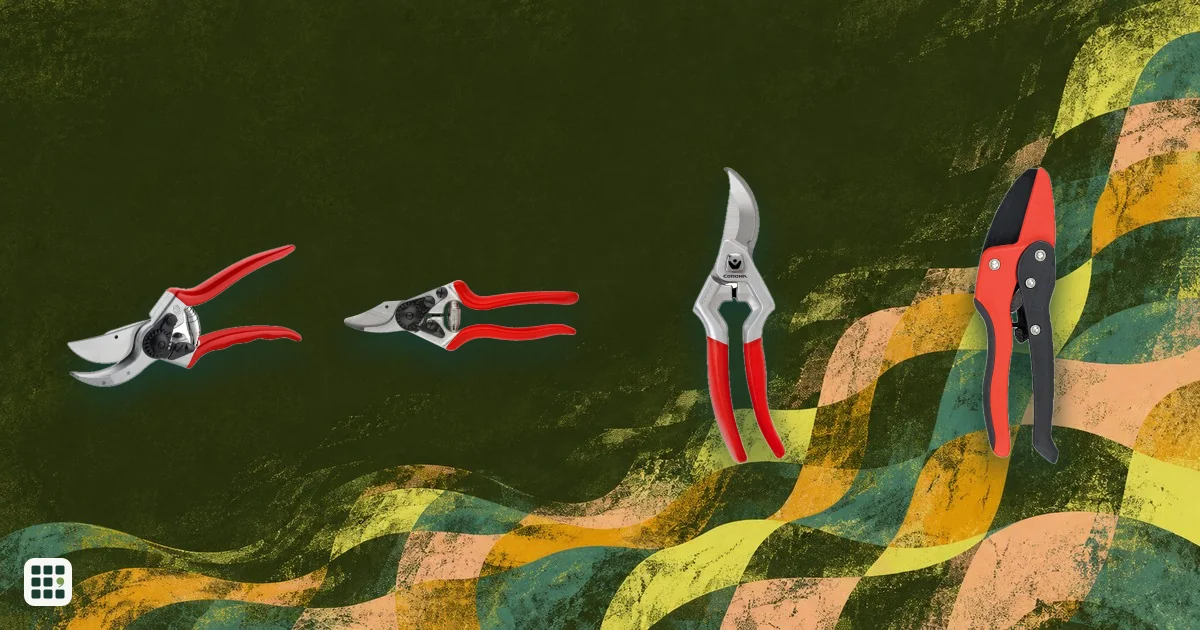
Pruning shears
Pruning shears (hand pruners or secateurs) are one-handed cutters for stems and small branches. The choice comes down to cut type (bypass slices live wood cleanly, anvil crushes dry wood, ratchet adds leverage), hand size, and whether you want a repairable tool that lasts decades or a cheap one you replace.
Last updated
How to choose
Start with what you cut. Live green stems, roses and fruit trees want a bypass pruner, whose blades pass each other like scissors and leave a clean cut. Anvil pruners press a blade onto a flat surface, which suits dead, dry wood but bruises green stems. Ratchet pruners cut in stages, easier on weak hands but slower.
Check fit first
- Measure your hand from the wrist crease to the tip of the middle finger; makers size pruners small, medium and large from that.
- Left-handed? Most bypass pruners are right-handed only; look for a mirrored model.
- Long sessions: a rotating handle or a lighter tool reduces blisters and strain.
Check capacity and cost
- Stay under the stated cutting capacity; forcing thicker wood bends blades.
- Look at replaceable blades, adjustable tension and what the warranty excludes (blades and springs usually are).
- Cheap pruners are fine for light yard work; a repairable pair costs more now and less over 20 years.
Before buying, ask: what is the thickest branch I cut, do I have small or large hands, and will I prune every week or twice a year?
Answer
Browse the table. Filter to what matters.
Use the filters below, then sign in if you want to shortlist and decide with friends.
Sign in to vote, hide products and features, and reorder.
Verified: hover a cell and click its green dot for the source Estimate: no cited source Not stated: the maker doesn't publish it
| Feature | ⠿ | ⠿ | ⠿ | ⠿ | ⠿ | ⠿ | ⠿ | ⠿ | ⠿ | ⠿ | ⠿ |
|---|---|---|---|---|---|---|---|---|---|---|---|
|
⠿
Price
|
$12.98
|
||||||||||
|
⠿
Cutting action
|
Bypass
|
||||||||||
|
⠿
Cutting capacity
|
0.625 in
|
||||||||||
|
⠿
Weight
|
|||||||||||
|
⠿
Overall length
|
|||||||||||
|
⠿
Hand size
|
|||||||||||
|
⠿
Handle material
|
Forged steel with non-slip grips
|
Steel with molded grip
|
Steel core with non-slip grip
|
||||||||
|
⠿
Rotating handle
|
|
|
|
|
|
|
|
|
|
|
|
|
⠿
Shock absorber
|
|
|
|
|
|||||||
|
⠿
Blade adjustment
|
|
|
|
|
|
||||||
|
⠿
Replaceable blade
|
|
|
|
||||||||
|
⠿
Warranty
|
Lifetime
|
||||||||||
|
⠿
Left handed use
|
Why these features matter
-
Price ($)
Price spans $13 to $111 here; pricier models mostly pay for repairable parts and fit, not a bigger cut.
-
Cutting action
Bypass cuts live green stems cleanly; anvil crushes but handles dry wood; ratchet trades speed for easier effort.
- Bypass
- : Blades pass like scissors for clean cuts on live green stems and flowers. Best all-round choice for most gardens.
- Anvil
- : A blade presses onto a flat surface. Strong on dry, dead wood but crushes green stems.
- Ratchet
- : Cuts in stages so each squeeze needs less force. Good for weak hands or thicker wood; slower.
-
Cutting capacity (in)
Forcing a branch beyond capacity bends blades; most garden jobs sit under 3/4 in.
-
Weight (lb)
Lighter tools tire the hand less over a long session.
-
Overall length (in)
Length changes leverage and whether the tool fits your hand and holster.
-
Hand size
A pruner that is too big or small causes cramps and poorer cuts; check your hand length first.
-
Handle material
Forged aluminum is light and strong; steel is heavier and cheaper.
- Aluminum
- : Light and strong, so the pruner tires the hand less over a long session.
- Steel
- : Heavier and cheaper than aluminum; fine for occasional use.
-
Rotating handle
A rotating handle cuts blisters and strain on repetitive cutting; skip it for occasional use.
-
Shock absorber
Cushions protect wrists and hands on repetitive cuts.
-
Blade adjustment
Adjustable tension keeps cuts clean as blades wear.
-
Replaceable blade
Repairable tools last decades; throwaways are cheaper up front.
-
Warranty
A lifetime warranty usually covers frame defects but not wear parts like blades.
-
Left handed use
Most precision bypass pruners are right-handed; lefties need a mirrored model.
About the products
-
2 · Felco
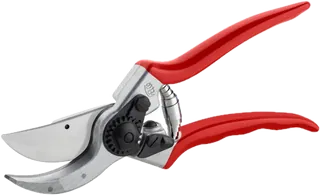
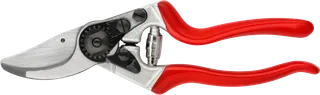
Swiss-made professional bypass pruner for large hands; the long-time benchmark. Forged aluminum handles, replaceable parts, shock absorbers.
-
6 · Felco
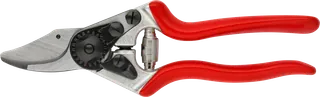
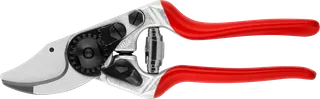
Compact Felco for medium hands with a 0.79 in cut; lighter than the 2 and easier on smaller wrists.
-
7 · Felco
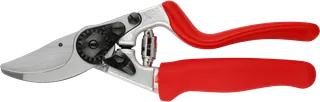
Felco with a revolving handle that spreads pressure across the fingers; for large hands and long sessions.
-
8 · Felco
Ergonomic Felco with an angled cutting head for large hands; same 0.98 in capacity as the 2 in a lighter body.
-
14 · Felco
Smallest Felco bypass pruner, for small hands; 0.71 in capacity and the lightest in this grid.
-
ClassicCUT BP 3180D · Corona
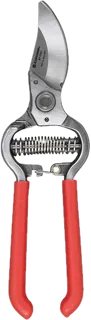
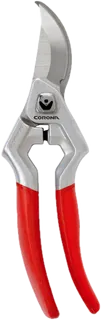
Forged-steel bypass pruner with a 1 in cut capacity and a resharpenable blade; best suited to medium to large hands.
-
ComfortGEL BP 3214D · Corona
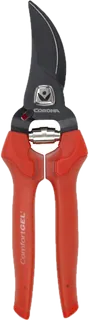
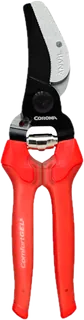
Low-cost full-steel bypass pruner with gel grips and a shock bumper; 3/4 in capacity.
-
XSeries Pro BP 16380 · Corona
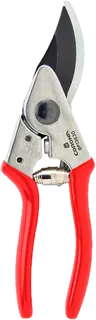
Aluminum-chassis bypass pruner with a geared pivot nut for blade adjustment and a replaceable blade; 1 in capacity.
-
RP 3230 Ratchet · Corona
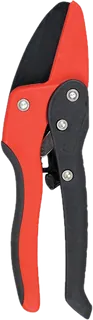
Ratchet-action pruner that multiplies hand power in stages; useful for weak hands or tougher wood, at a 3/4 in capacity.
-
ComfortGEL AP 3334 Anvil · Corona
Anvil pruner with a serrated anvil and gel grips for dry and woody branches up to 3/4 in; crushes rather than slices green stems.
-
Classic Steel Bypass 391091-4003 · Fiskars
Budget Fiskars steel bypass pruner with a 5/8 in cut capacity and an easy-open lock; for stems and light branches. Sold at big-box stores; the maker no longer lists it on its US site.
Suggest a change
Related comparisons
-
 String trimmers
 (weed eaters, weed whackers) cut grass and weeds where a mower cannot reach. This grid compares cordless models across battery platform, swath, line size, weight, runtime and whether they take attachments or convert to an edger.
-
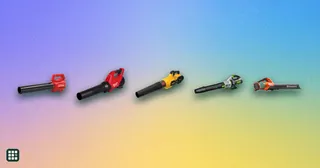 Leaf blowers
Compare cordless leaf blowers for yard size, debris, noise sensitivity, runtime, and battery platform. Prices and included batteries vary by kit.
-
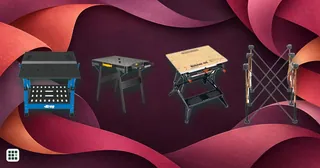 Portable workbenches
 fold flat so you can carry them to the job and store them in a closet or car. The real decisions are how much work surface you need, how much weight it holds, and whether it clamps work for you or you bring your own clamps.
-
 Multi-tools
Pocket multi-tools trade carry weight and size against pliers, cutting tools, drivers, and specialist gear. This comparison covers compact everyday carry models and larger repair and outdoor tools; check the actual implement list, blade dimensions, included pouch, and warranty before choosing.
-
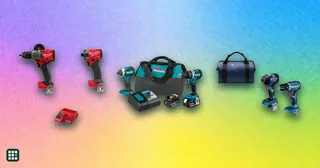 Cordless drill and driver kits
Compare ten 12V, 18V, 20V and 24V cordless tool kits across multiple battery ecosystems. Battery systems lock in future bare-tool purchases, so compare the included batteries and charger alongside tool power. Maximum torque figures are manufacturer ratings and do not make unlike tools directly equivalent in real work.
-
 Greenhouses
Greenhouse kits let you start seedlings early, protect tender crops from frost and grow through a longer season. This grid compares backyard walk-in kits from small budget aluminum and polycarbonate models to premium and wood-framed greenhouses on size, glazing, weather ratings, vents, doors, warranty and price. The main trade-off is price against strength and insulation: budget kits are cheap but state few weather ratings, while premium kits cost many times more.