



Beginner telescopes
Beginner telescopes trade simplicity, aperture, and price. Compare refractors, reflectors and Maksutovs, hand-guided, app-assisted and GoTo finding, and tabletop and floor-standing Dobsonians.
Last updated
How to choose
Start with how you want to find targets
A manual mount is simple and needs no power, but you point and track by hand. Smartphone guidance helps you locate objects without motors. GoTo mounts can point and track automatically, with extra alignment and power steps.
Compare aperture and design
A larger aperture gathers more light, but the full kit takes more space. Refractors need little optical maintenance; Newtonian reflectors offer more aperture for the price but may need occasional mirror alignment.
Plan where you will set it up
Tabletop Dobsonians need a sturdy level surface. Full-height tripods stand on the ground but can be taller and heavier to carry. The optical tube weight shown here excludes its mount and tripod.
Answer
Browse the table. Filter to what matters.
Use the filters below, then sign in if you want to shortlist and decide with friends.
Sign in to vote, hide products and features, and reorder.
Verified: hover a cell and click its green dot for the source Estimate: no cited source Not stated: the maker doesn't publish it
| Feature | ⠿ | ⠿ | ⠿ | ⠿ | ⠿ | ⠿ | ⠿ | ⠿ | ⠿ | ⠿ | ⠿ | ⠿ | ⠿ | ⠿ | ⠿ | ⠿ | ⠿ |
|---|---|---|---|---|---|---|---|---|---|---|---|---|---|---|---|---|---|
|
⠿
Optical design
|
Newtonian reflector, tabletop Dobsonian
|
||||||||||||||||
|
⠿
Aperture
|
|||||||||||||||||
|
⠿
Focal length
|
|||||||||||||||||
|
⠿
Mount
|
Manual tabletop Dobsonian
|
||||||||||||||||
|
⠿
Guidance app
|
Doesn't apply
|
Doesn't apply
|
Doesn't apply
|
Doesn't apply
|
Doesn't apply
|
||||||||||||
|
⠿
Optical tube weight
|
|||||||||||||||||
|
⠿
Price
|
|||||||||||||||||
|
⠿
Focal ratio
|
|||||||||||||||||
|
⠿
Highest useful magnification
|
|||||||||||||||||
|
⠿
Limiting stellar magnitude
|
|||||||||||||||||
|
⠿
Eyepieces included
|
25mm Plossl
|
||||||||||||||||
|
⠿
Finderscope
|
Red dot
|
||||||||||||||||
|
⠿
Total weight
|
20 lb
|
23.5 lb
|
40 lb
|
45 lb
|
|||||||||||||
|
⠿
Motorized GoTo
|
|
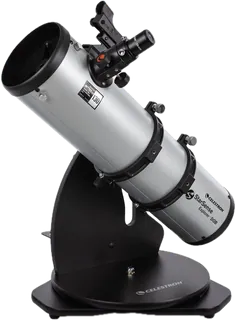
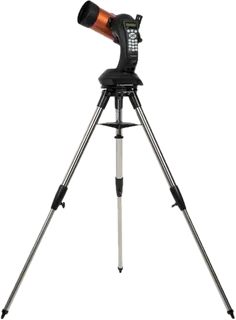
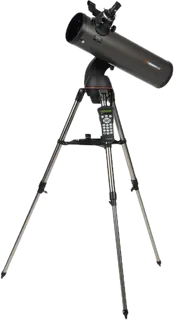
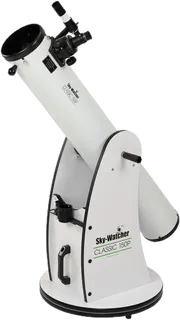
Why these features matter
-
Optical design
Refractors are low-maintenance; reflectors often provide more aperture for the price.
- Refractor
- : Uses a lens. Sealed tube needs almost no adjustment, but large lenses cost more per inch of aperture.
- Newtonian reflector
- : Uses mirrors. More light gathering per dollar, with an open tube that may need an occasional mirror alignment.
- Maksutov-Cassegrain
- : A folded design with a short, compact tube and long focal length. Good for the Moon and planets, with a narrow view of the sky.
- Dobsonian
- : A Newtonian on a simple rocker base you push by hand. The most aperture for the money; the tabletop versions need a sturdy surface.
-
Aperture (mm)
A wider aperture gathers more light and can reveal fainter objects; larger scopes are bulkier.
-
Focal length (mm)
Longer focal lengths support higher magnification with the same eyepiece; shorter lengths show wider views.
-
Mount
Manual mounts are simple and lower-cost; GoTo can find and track targets but adds setup and power needs.
- Manual alt-azimuth
- : A tripod head that moves up/down and left/right by hand. Simple, no power needed, but you re-center the target as the sky turns.
- Dobsonian base
- : A rocker base you push by hand. Very stable and quick to set up; tabletop bases need a table or raised surface.
- GoTo
- : Motors and a computer point at targets and follow them. It needs power and a short alignment, but saves hunting for objects.
-
Guidance app
A target-finding app can make the first observing sessions easier; manual scopes can be used with separate sky charts.
- StarSense Explorer
- : Your phone camera recognizes the stars and shows you which way to push the scope. It guides you but does not move the mount.
- SkyPortal
- : A sky-reference and planning app; on manual scopes it does not point the telescope.
- ExploreStars
- : Controls the motorized mount for automatic pointing and tracking.
-
Optical tube weight (lb)
The tube weight affects carrying and which mounts can support it; it is not the full kit weight.
-
Price ($)
Price helps compare a simple manual kit with larger-aperture or app-guided packages.
-
Focal ratio
A lower focal ratio shows wider fields and brighter faint objects; a higher one gives steadier high-power views of the Moon and planets.
-
Highest useful magnification (x)
It is the practical ceiling for zoom; beyond it the image only gets dimmer and blurrier. Larger apertures reach higher.
-
Limiting stellar magnitude
A higher number means the scope can show dimmer stars and deep-sky objects, mostly under dark skies.
-
Eyepieces included
Two eyepieces cover low and high power at the start; a kit with one eyepiece needs an extra purchase for more magnification choices.
- 20mm and 10mm
- : A low-power and a higher-power eyepiece. Two choices cover the Moon, planets, and bright clusters to start.
- 25mm and 10mm
- : A wide, low-power eyepiece and a higher-power one; the 25mm gives an easier first view of larger objects.
- Barlow included
- : A Barlow lens doubles the power of each eyepiece, giving more magnification choices from the same kit.
-
Finderscope
A finder is how you aim; red dot finders are easier for new users, magnified ones show a few stars to match against a chart.
- Red dot
- : Shows a dot on the sky through a window. The easiest finder for beginners to aim with.
- Magnified finderscope
- : A mini-telescope that shows the star field; more precise once you can read a star chart, harder to learn.
-
Total weight (lb)
Heavier kits are more stable but harder to carry and store; matters most if you travel or have no ground-floor access.
-
Motorized GoTo
GoTo finds targets for you but needs batteries or power and a short alignment; manual scopes are simpler and cheaper.
About the products
-
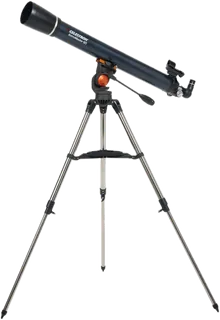
AstroMaster LT 70AZ · Celestron
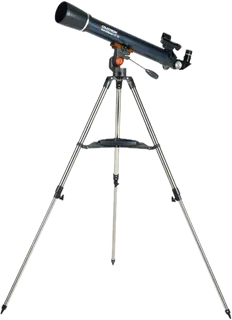
A 70 mm refractor with a simple manual alt-az mount and no-tool setup. Its included SkyPortal software is a sky reference app, not a motorized mount.
-
StarSense Explorer LT 80AZ · Celestron
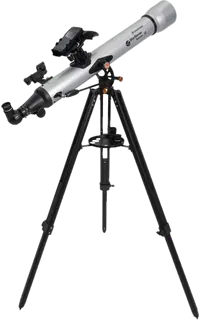
An 80 mm refractor with smartphone-assisted target finding on a manual alt-az mount. The phone dock and full-height tripod make this a guided entry option without motors.
-
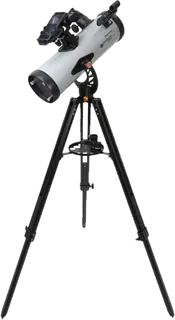
StarSense Explorer DX 130AZ · Celestron
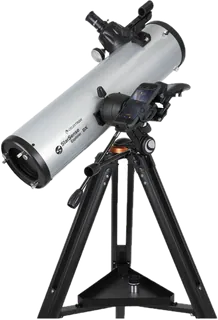
A 130 mm Newtonian reflector with app-guided finding and a manual alt-az mount with slow-motion controls. It gathers more light than the small refractors but the full-height tripod makes it less compact.
-
Heritage 130 Tabletop Dobsonian · Sky-Watcher
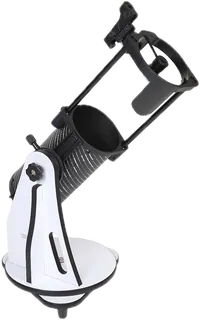
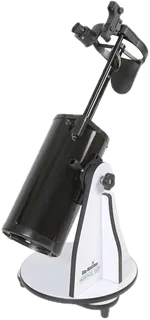
A collapsible 130 mm Newtonian tabletop Dobsonian with a manual push-to base. It needs a steady raised surface, and the open tube is compact to store. Current maker sale pricing is below the listed price.
-
Heritage 150 Tabletop Dobsonian · Sky-Watcher
A collapsible 150 mm tabletop Dobsonian with 44% more light-gathering area than the 130 mm Heritage, according to the maker. It needs a sturdy raised surface; the current maker sale price is below list.
-
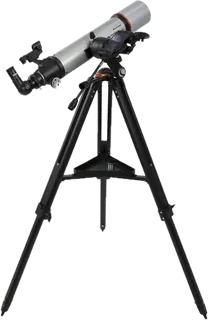
FirstLight 80mm GoTo EQ · Explore Scientific
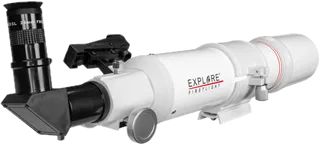
An 80 mm refractor bundled with a motorized German equatorial GoTo mount and ExploreStars app. It can locate and track targets automatically, but the mount and tripod make the package heavier and more involved to set up.
-
Travel Scope 70 · Celestron
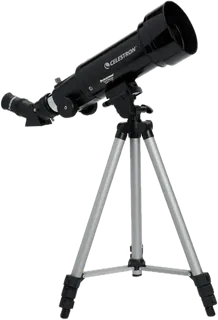
A 70 mm refractor that packs into the included backpack: tube and tripod together weigh a few pounds. Small aperture, so best for the Moon, planets, and bright clusters, and a good travel or first scope.
-
AstroMaster 90AZ · Celestron
A 90 mm refractor on a manual alt-azimuth tripod with an erect-image diagonal. A step up in light gathering from the 70 mm AstroMaster, with no motors or app guidance.
-
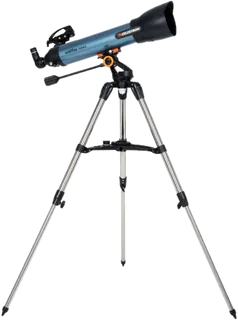
Inspire 100AZ · Celestron
A short 100 mm refractor with an integrated smartphone adapter, red LED flashlight, and a panning-handle alt-az mount. Large aperture for a refractor in this group, at the cost of weight.
-
StarSense Explorer DX 102AZ · Celestron
A 102 mm refractor with the StarSense Explorer phone dock: the app uses the phone camera to recognize the sky and guide you to targets by hand. No motors.
-
StarSense Explorer LT 114AZ · Celestron
A 114 mm Newtonian reflector with the StarSense Explorer phone dock for guided finding, at a lower price than the DX models. Manual mount; a good aperture for the money.
-
StarSense Explorer 130mm Tabletop Dobsonian · Celestron
A 130 mm Newtonian on a tabletop Dobsonian base with the StarSense Explorer app for guided finding. It needs a sturdy table or raised surface and has a steel tube that is not collapsible.
-
NexStar 4SE · Celestron
A compact 102 mm Maksutov-Cassegrain on a motorized single-fork GoTo mount with a hand control database. Long focal length and narrow field favor the Moon and planets; needs 8 AA batteries or power. Current maker sale pricing is below the list price.
-
NexStar 130SLT · Celestron
A 130 mm Newtonian on a motorized GoTo fork mount with a 40,000-object hand control. More aperture than the NexStar 4SE at the cost of a bulkier tube; needs 8 AA batteries or power.
-
Classic 150P Dobsonian · Sky-Watcher
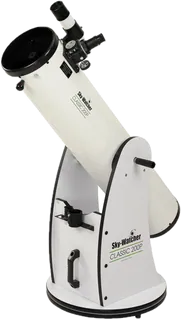
A full-size 6-inch (152 mm) Newtonian on a manual rocker-box Dobsonian base with a 6x30 finderscope and two eyepieces. Much more light gathering per dollar than the small refractors, but it needs floor space and a car to move. Current maker sale pricing is below the list price.
-
Classic 200P Dobsonian · Sky-Watcher
An 8-inch (203 mm) Newtonian on a manual rocker-box Dobsonian base. The most light gathering here for the price and a classic upgrade path for beginners, but the 20 lb tube and 25 lb base need space and a vehicle. Current maker sale pricing is below the list price.
-
6-inch Tabletop Dobsonian · Explore Scientific
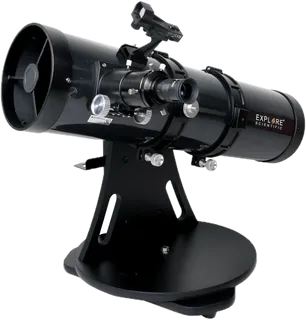
A 152 mm f/5 Newtonian tabletop Dobsonian. A 6-inch aperture in a table-sized base, at about 22 lb assembled; it needs a sturdy raised surface. Current maker sale pricing is below the list price.
Suggest a change
Related comparisons
-
 Beach umbrellas
A beach umbrella has to do two jobs: shade you from the sun and stay put when the wind picks up. This grid compares portable beach umbrellas on canopy size, how they anchor into the sand, claimed wind resistance, UV protection, and what you get in the box, so you can weigh a heavy sand-filled base against a light screw-in anchor.
-
 Tents
Popular camping tents side by side, from ultralight trekking-pole shelters to roomy family cabins. The choice comes down to how far you carry it: every pound saved costs money and some durability, while car camping tents trade weight for space, standing height and easy setup. Weather, ground and how many people (and dogs) share it decide the rest.
-
 Camping cots
 get you off cold, lumpy, wet ground. The choice is mostly about where the cot travels: ultralight aluminum cots pack into a backpack but sit low and cost more, while steel car-camping cots are cheap, tall and roomy but weigh 20 to 30 lb. Tent cots and bunk cots trade even more bulk for a built-in shelter or a second bed.
-
 Pet GPS trackers
Compare pet GPS trackers by actual coverage method, subscription cost, escape alerts, battery, weight, water protection, health features, and whether a phone or handheld is needed. Cellular trackers can locate pets over long distances where a supported network is available; radio systems can work off-grid but require compatible equipment and are affected by terrain. Confirm fit for the pet’s size and review the service plan before buying.
-
 Golf rangefinders
Laser golf rangefinders compared on the things that change your yardages: slope and whether you can switch it off for tournaments, magnification and range, accuracy, pin-lock feedback, stabilization, display, battery, water resistance, weight, and price. Budget lasers now measure about as accurately as flagships; the extra money mostly buys brighter optics, steadier views, environmental slope, and GPS.
-
 Bluetooth speakers
Compare portable Bluetooth speakers from JBL, Bose, Sony, Ultimate Ears, Marshall, Sonos, Beats, soundcore, Tribit, and more, from pocket-size clip-ons to party speakers. The real choices are size and loudness against weight, battery life, how waterproof it is, and extras like linking several speakers, charging your phone, or streaming over Wi-Fi at home.