



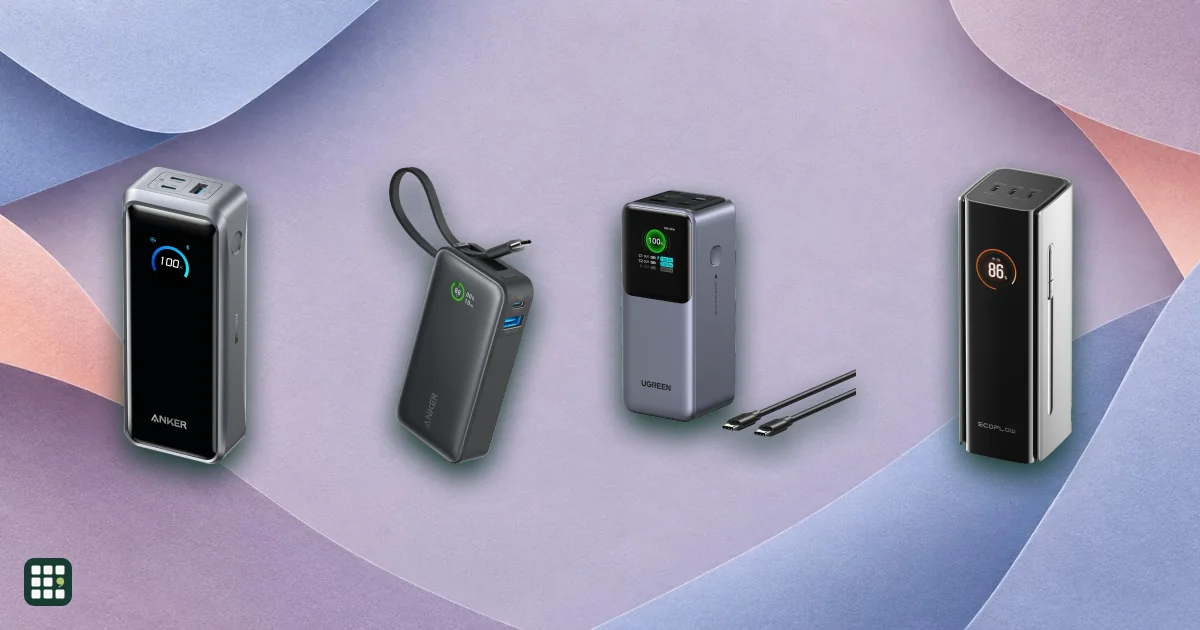
Power banks
Power banks compared: pocket 10,000 mAh packs, magnetic Qi2 and MagSafe-style batteries, and high-wattage USB-C banks that charge laptops, from Anker, UGREEN, Belkin, Baseus, EcoFlow, INIU and others. The choice comes down to how much usable energy you need, how fast it charges your devices and itself, the ports you use, and how much weight you want to carry.
Last updated
How to choose
Size it by watt-hours, not just mAh
Rated mAh is measured at the battery cell voltage, so only about 60 to 70 percent reaches your phone. Watt-hours compare banks fairly: a typical phone battery is 12 to 20 Wh, so a 37 Wh (10,000 mAh) bank gives about two phone charges, and a 90 Wh bank can top up a laptop once.
Match the output to your devices
- Phones: 20 to 30 W USB-C fast-charges most phones.
- Tablets and small laptops: 45 to 65 W from a single port.
- Larger laptops: 100 W or more from one USB-C port, and a bank with enough watt-hours to matter.
Ports, cables and magnetic charging
Built-in cables save forgetting one; extra USB-C ports let you charge several devices. Magnetic Qi2 packs are convenient for iPhones and newer Android phones but charge more slowly and waste more energy as heat than a cable.
Recharging the bank
High-input banks refill in an hour or two with a fast wall charger; low-input banks can take all night. Pass-through charging lets you charge the bank and a phone from one outlet.
Flying with power banks
US airline rules (FAA) allow power banks up to 100 Wh in carry-on bags, require airline approval for 101 to 160 Wh (two per person), forbid anything over 160 Wh, and ban power banks from checked bags. Some airlines now restrict using or charging power banks in flight, so check before you fly.
Weight and safety
A 10,000 mAh bank weighs about 6 to 8 oz; laptop banks often exceed a pound. Buy from known brands, avoid damaged or swollen batteries, and keep them out of hot cars.
Answer
Browse the table. Filter to what matters.
Use the filters below, then sign in if you want to shortlist and decide with friends.
Sign in to vote, hide products and features, and reorder.
Verified: hover a cell and click its green dot for the source Estimate: no cited source Not stated: the maker doesn't publish it
| Feature | ⠿ | ⠿ | ⠿ | ⠿ | ⠿ | ⠿ | ⠿ | ⠿ | ⠿ | ⠿ | ⠿ | ⠿ | ⠿ | ⠿ | ⠿ | ⠿ | ⠿ | ⠿ | ⠿ |
|---|---|---|---|---|---|---|---|---|---|---|---|---|---|---|---|---|---|---|---|
|
⠿
Price
|
$259.99
|
$109.99
|
$89.73
|
$99.99
|
$69.99
|
$214.99
|
|||||||||||||
|
⠿
Capacity
|
|||||||||||||||||||
|
⠿
Energy
|
37 Wh
|
88.8 Wh
|
37 Wh
|
37 Wh
|
37 Wh
|
37 Wh
|
37 Wh
|
37 Wh
|
74 Wh
|
37 Wh
|
|||||||||
|
⠿
Usable capacity
|
|||||||||||||||||||
|
⠿
Max total output
|
17 W
|
||||||||||||||||||
|
⠿
Max single port output
|
140 W
|
||||||||||||||||||
|
⠿
Ports
|
1 USB-C, 2 built-in USB-C cables, 1 USB-A
|
1 USB-C, magnetic wireless pad
|
1 USB-C
|
2 USB-C, 1 USB-A
|
2 USB-C, 1 USB-A
|
1 USB-C (input and output)
|
|||||||||||||
|
⠿
Wireless charging
|
None
|
None
|
None
|
None
|
None
|
None
|
None
|
None
|
None
|
None
|
None
|
None
|
None
|
||||||
|
⠿
Recharge input
|
140 W
|
20 W
|
30 W
|
||||||||||||||||
|
⠿
Recharge time
|
About 2.75 hours (165 min)
|
||||||||||||||||||
|
⠿
Pass through charging
|
|
|
|||||||||||||||||
|
⠿
Display
|
LED battery lights
|
||||||||||||||||||
|
⠿
Weight
|
|||||||||||||||||||
|
⠿
Dimensions
|
|||||||||||||||||||
|
⠿
Laptop charging
|
|
|
|
|
|
|
|
|
|
|
|
||||||||
|
⠿
Warranty
|
24 months
|
24 months
|
24 months
|

Why these features matter
-
Price ($)
Basic 10,000 mAh banks cost $20 to $40; fast laptop banks and magnetic Qi2 packs run $60 to $150.
-
Capacity (mAh)
Bigger numbers mean more charges, but rated mAh overstates what reaches your phone.
-
Energy (Wh)
Watt-hours compare banks fairly and decide airline rules: up to 100 Wh is allowed in carry-on without approval.
-
Usable capacity
Real output is typically 60 to 70 percent of the cell rating after voltage conversion and losses.
-
Max total output (W)
Total output decides how fast several devices charge at once. Some cheap banks fall to 15 W total as soon as a second device is plugged in.
-
Max single port output (W)
Laptops need 45 to 100 W from one port; phones fast-charge at 20 to 45 W.
-
Ports
Built-in cables mean one less thing to forget; extra ports let you charge several devices.
- USB-A port
- : The older, rectangular USB plug. Handy for older cables, earbuds and watches; not needed if all your gear uses USB-C.
-
Wireless charging
Magnetic packs snap onto iPhones and Qi2 Android phones, but wireless charging is slower and less efficient.
- Qi2.2 25 W
- : The newer magnetic wireless standard: up to 25 W to iPhone 16 and later, about as fast as a 20 W cable. Older iPhones and phones without Qi2 get 15 W or less.
- Qi2 15 W
- : Magnetic wireless charging at up to 15 W, matching Apple's older MagSafe speed. Works with iPhone 12 and later and Qi2 Android phones.
-
Recharge input (W)
Fast input refills a large bank in about an hour instead of overnight.
-
Recharge time
Matters on trips with short layovers or overnight stops.
-
Pass through charging
Pass-through lets one wall outlet charge the bank and your phone overnight.
-
Display
A display shows exact charge left and how fast devices are charging.
-
Weight (oz)
Light banks fit a pocket; laptop banks often weigh over a pound.
-
Dimensions (in)
Shape matters as much as weight for pockets and small bags.
-
Laptop charging
A laptop-capable bank can replace a second charger on trips.
-
Warranty
Batteries degrade; a longer warranty covers early failures.
About the products
-
Anker Prime Power Bank (26K, 300W) · Anker
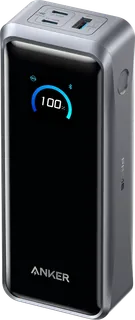
A 26,250 mAh laptop bank that can feed three devices at 300 W combined and refill to 50% in about 13 minutes when both USB-C ports are plugged into 140 W chargers. It is heavy (about 1.3 lb) and expensive, so it suits people who travel with a laptop rather than phone-only users.
-
Anker Nano Power Bank (30W, Built-In USB-C Cable) · Anker
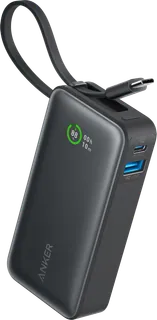
A pocket 10,000 mAh bank with a built-in USB-C cable that doubles as a handle, plus a USB-C and a USB-A port and a small color screen. A single port tops out at 30 W and the combined output is only 24 W, so it is for phones and earbuds, not laptops.
-
Anker 737 Power Bank (PowerCore 24K) · Anker
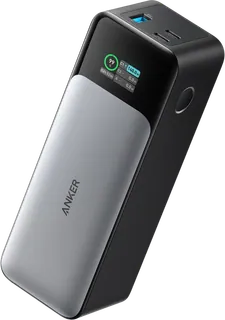
A 24,000 mAh, 140 W bank with a smart display that can run a laptop and two phones at once. It is an older design that recharges through one USB-C port only and weighs about 1.4 lb; the newer Anker Prime refills much faster.
-
Laptop Power Bank (25K, 165W, Built-In and Retractable Cables) · Anker
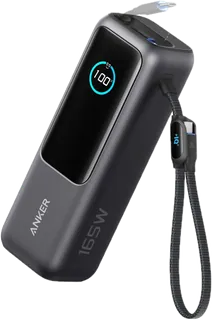
A 25,000 mAh (90 Wh) bank with two built-in USB-C cables (one retractable), a spare USB-C port and a USB-A port, 100 W from any USB-C and 165 W total. A smart display shows live power. At 21 oz it suits laptop users who want no loose cables; it is heavy for phone-only use.
-
MagGo Power Bank (10K) · Anker
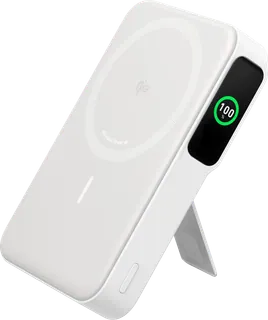
A 10,000 mAh Qi2 magnetic bank with 15 W wireless charging, a fold-out stand and a smart display, aimed at iPhone users. It has only one USB-C port (27 W) and is fairly thick and heavy for a magnetic pack.
-
MagGo 2 Pro Magnetic Power Bank (10K, Qi2 25W, Active Cooling) · Anker
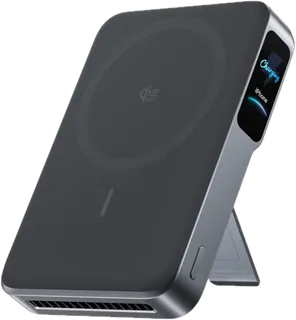
A 10,000 mAh Qi2.2 magnetic bank with 25 W wireless charging for iPhones, a built-in fan to keep the phone cooler while charging, a fold-out stand and a smart display. It recharges at up to 45 W; it costs more than other 10K magnetic packs.
-
MagGo Power Bank (10K, Slim) · Anker
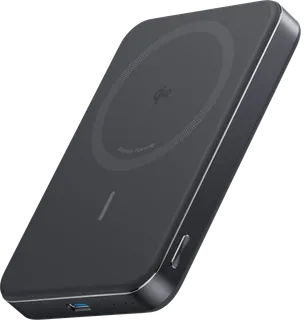
Anker's thin (0.58 in) 10,000 mAh Qi2 magnetic pack with 15 W wireless charging and one 30 W USB-C port. It is slimmer and cheaper than the MagGo 10K with stand and display, but has no stand or screen, and only 12 W wired plus 5 W wireless when charging two devices at once.
-
UltraCharge Pro Power Bank 10K with Magnetic Ring · Belkin
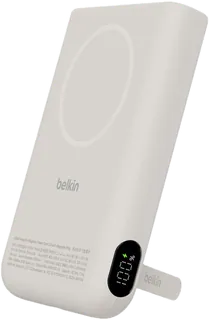
Belkin's current 10,000 mAh magnetic Pro bank with Qi2.2 25 W wireless charging, a kickstand, a digital battery display and a magnetic ring for accessories. Charging two devices at once drops both to 15 W, and the full 25 W while plugged in needs a 36 W charger that isn't included.
-
mophie powerstation plus 10K (Signature Series) · mophie
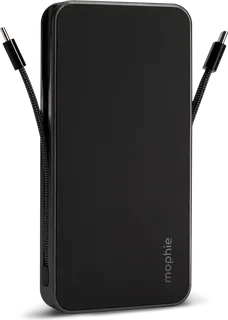
A 10,000 mAh bank with two built-in braided USB-C cables plus a USB-C port, so you can charge three devices without carrying cords. It tops out at 30 W, shows charge on four LEDs only, and costs more than plainer 10K banks.
-
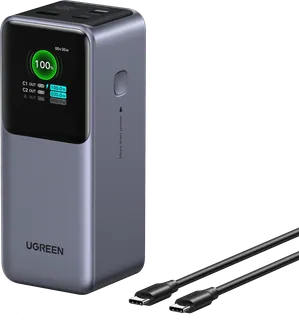
Nexode Power Bank 20000mAh 130W with Smart Digital Display · UGREEN
An upright 20,000 mAh (72 Wh) bank with a TFT status screen, 100 W from its main USB-C port and 130 W total across three ports. Recharging is limited to 65 W through one port, so a full refill takes a while. The current maker sale is $59.99 against an $89.99 list price (checked Nov 13, 2026).
-
Nexode Power Bank 25000mAh 145W (3-Port) · UGREEN
A 25,000 mAh (90 Wh) laptop bank with up to 140 W from one USB-C port and 145 W total, at a lower price than most 140 W banks. It recharges at only 65 W (about 2 hours) and shows charge on a simple LED display. The current maker sale is $69.99 against a $99.99 list price (checked Nov 13, 2026).
-
Pawsible Power Bank 10000mAh 45W (P41) · INIU
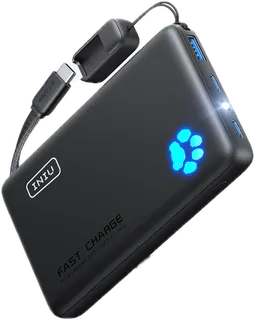
INIU's best-selling budget 10,000 mAh bank, with two USB-C ports and a USB-A port, 45 W fast charging and a 3-year warranty, for about $24. Charging two or three devices at once drops the total to 15 W. Charge is shown on a paw-print LED rather than a numeric display, and INIU publishes few other specs.
-
Carry P50 Power Bank 10000mAh 45W (Pocket Rocket) · INIU
INIU's newer palm-sized 10,000 mAh bank with 45 W fast charging, a digital display and a 3-year warranty. It is smaller and lighter than the Pawsible P41 but costs more, and total output across ports is capped at 15 W.
-
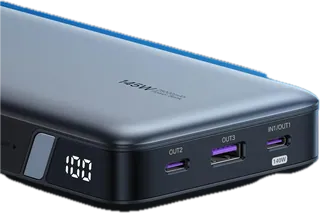
Blade H1 Digital Display Power Bank 20000mAh 100W · Baseus
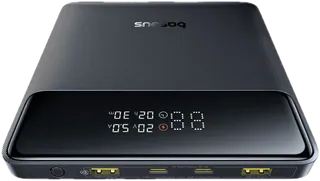
A thin, flat 20,000mAh laptop power bank with 100W USB-C output and a status display; it slides into a laptop sleeve more easily than brick-shaped banks. At about 1 lb it is heavy for a pocket, and Baseus publishes few detailed port specs.
-
PicoGo AM61 Qi2.2 Magnetic Power Bank 10000mAh 45W · Baseus
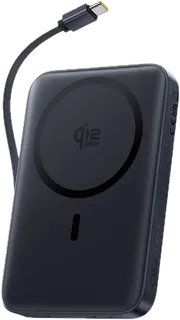
A 10,000mAh magnetic pack that snaps onto iPhones and Qi2 phones with Qi2.2 25W wireless charging, plus 45W over USB-C. It is not a laptop bank, and Baseus lists few input or recharge details.
-
Shargeek 170 (170W, 24K) · Sharge
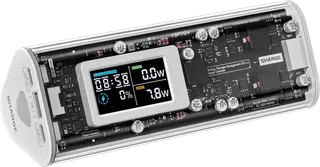
A 24,000mAh, 86.4Wh laptop power bank with two 140W USB-C ports, a USB-A port and a smart display, and it refills quickly at up to 140W. At about 1.5 lb it is a bag item, not a pocket one, and the warranty is only 12 months.
-
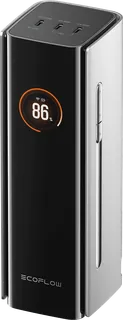
RAPID Pro Power Bank (27,650mAh, 300W, 140W Built-in Cable) · EcoFlow
One of the most powerful carry-on-legal banks: 99.54Wh, 300W across four outputs (including a retractable 140W USB-C cable) and an LCD screen with app control. It weighs over 1.5 lb, and the fastest refill needs EcoFlow's 320W charging station.
-
Nitecore NB10000 Gen4 · Nitecore
An ultralight 10,000mAh bank (about 5 oz) for hikers and runners, with IPX7 waterproofing, two USB-C ports at up to 22.5W and a lanyard charging cable. It is USB-C only, has no screen, and drops to 15W total when both ports are in use.
-
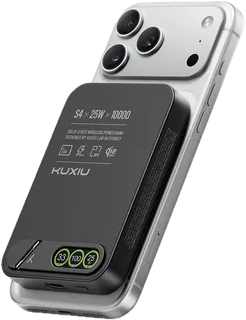
KUXIU S4 Qi2.2 25W 10000mAh Wireless Power Bank · KUXIU
A 10,000mAh aluminum magnetic pack with a semi-solid-state cell, Qi2.2 25W wireless charging and a small TFT screen showing battery health, temperature and charging power. Wired output tops out at 30W, so it is for phones and earbuds, not laptops.
Suggest a change
Related comparisons
-
 Portable tire inflators
 compared: pocket-size cordless pumps with built-in batteries, inflators that run on Ryobi, DeWalt, Milwaukee and other tool batteries, and 12V and AC/DC compressors for cars, trucks and off-road tires. The choice is about the tires you fill, how fast you need it done, where it will live in your car, and whether you want it to run off a battery or never run out of power.
-
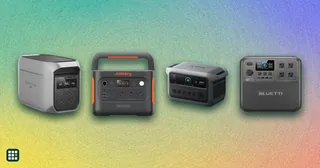 Portable power stations
Compare portable power stations for camping, RV trips, and emergency backup. The grid covers compact and roughly 2 kWh models from EcoFlow, Jackery, Anker SOLIX, and BLUETTI.
-
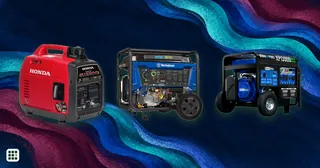 Portable generators
Compare portable gas generators by usable running power, fuel choices, portability, noise and safety features. Small inverter models suit camping and electronics; larger open-frame and dual-fuel models can handle more household loads but are heavier and louder.
-
 Upright freezers
An upright freezer has shelves and a door like a refrigerator, so food is easier to find and rotate than in a chest freezer, and it fits a kitchen, garage or basement corner. The real choices are size against the floor space you have, frost-free versus manual defrost, and whether the unit can handle a garage.
-
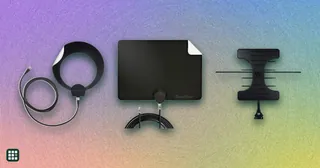 TV antennas
An over-the-air TV antenna gets local broadcast channels (ABC, CBS, NBC, Fox, PBS and more) free, with no subscription. This grid compares indoor flat and tabletop antennas with attic and rooftop models on claimed range, the bands they receive, amplification, size, and what comes in the box. The trade-off is simple: the closer you are to the towers, the smaller and cheaper the antenna can be; far from them, an outdoor directional antenna is worth the installation work.
-
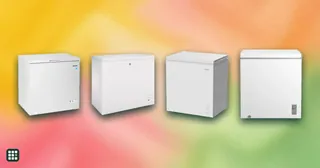 Chest freezers
A chest freezer stores bulk meat, garden produce, and stock-up groceries more efficiently than an upright, because cold air stays in when you open the lid. The real choice is size versus the wall space you have, and whether the unit can hold temperature in a garage.