



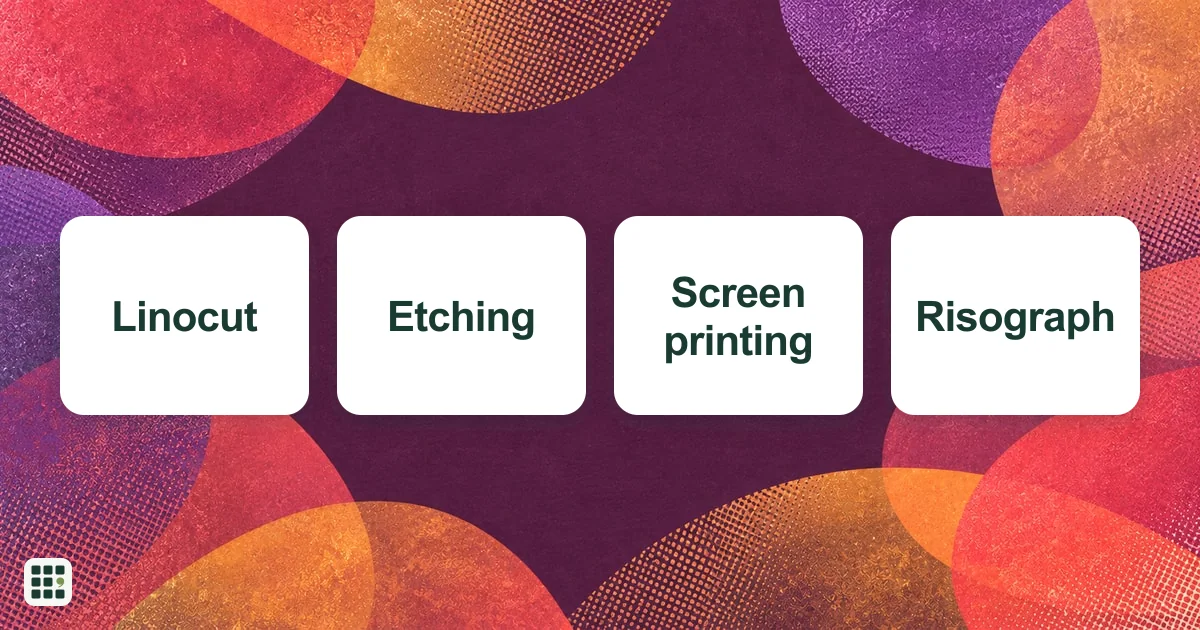
Printmaking techniques
Printmaking turns one design into a set of prints. The techniques differ in how the image is made on the plate or block, which tools and equipment you need, how many good prints you can pull, what the lines look like, and what it costs to start. This grid compares twelve techniques so you can match one to your budget, space, and the look you want.
Last updated
How to choose
Start with the look you want, then check what you can afford and where you can work.
Decide what matters
- Look: bold shapes suit woodcut and linocut; fine line and tone suit etching, engraving, and aquatint; painterly one-offs suit monotype; flat layered colour suits screen printing and risograph.
- Equipment: relief prints and monotypes can be printed by hand with a spoon or baren, while intaglio and lithography normally need a press, usually in a shared studio.
- Chemicals: etching, aquatint, and lithography use acids or solvents, which means ventilation, gloves, and ideally a supervised studio.
- Edition: if you want many identical copies, check how fast the plate wears; drypoint wears quickly and a monotype gives one print.
Check the full cost
Tools are cheap for relief printing. For other methods, factor in studio membership or press time, plate metal, papers, and inks. Costs here are rough starting figures, so confirm local prices.
Before you commit
Take an intro class or open studio session first. Most community print studios let you try a technique for an afternoon, which is the cheapest way to find out whether you enjoy it.
Answer
Browse the table. Filter to what matters.
Use the filters below, then sign in if you want to shortlist and decide with friends.
Sign in to vote, hide services and features, and reorder.
Verified: hover a cell and click its green dot for the source Estimate: no cited source
| Feature | ⠿ | ⠿ | ⠿ | ⠿ | ⠿ | ⠿ | ⠿ | ⠿ | ⠿ | ⠿ | ⠿ | ⠿ |
|---|---|---|---|---|---|---|---|---|---|---|---|---|
|
⠿
Process
|
||||||||||||
|
⠿
Cost to start
|
$45
|
$35
|
$150
|
$175
|
$175
|
$80
|
$250
|
$90
|
$40
|
$50
|
$60
|
$150
|
|
⠿
Learning curve
|
Moderate, carving takes control
|
Easy, soft material and simple tools
|
Steep, acid, grounds and press skills
|
Steep, burin control takes years
|
Steep, timing and rosin control
|
Moderate, easy to draw, plate wears fast
|
Steep, chemistry and press balance
|
Moderate, stencils and registration
|
Easy, paint and press
|
Moderate, colour management
|
Moderate, colour separation and layers
|
Steep, several methods to learn
|
|
⠿
Tools and equipment
|
Plate, incising tool or acid, etching press
|
|||||||||||
|
⠿
Edition size
|
50-200 prints
|
20-100 prints
|
20-100 prints
|
100+ prints
|
20-100 prints
|
50-200 prints
|
50-500 prints
|
20-100 prints
|
||||
|
⠿
Line and texture
|
Bold lines, visible wood grain
|
Flat, bold layered colour
|
Smooth continuous tone, photographic detail
|
|||||||||
|
⠿
Famous practitioners
|
Zine and comic artists in riso studios
|
Why these features matter
-
Process
The process decides the equipment, the safety needs, and the look, so it is the first thing to match to your situation.
-
Cost to start ($)
Start-up cost ranges from a few dollars for linocut tools to a few hundred for metal plate work, which can decide what you try first.
-
Learning curve
Easier techniques give quick results and keep beginners motivated; harder ones take guided classes and practice.
-
Tools and equipment
Shows whether you can work at a kitchen table or need studio access to a press, acid bath, or machine.
-
Edition size
If you want many matching copies to sell or share, you need a technique whose plate lasts; if you want one-offs, edition size hardly matters.
-
Line and texture
Each technique has a recognisable look, so choose the one that matches the images you want to make.
-
Famous practitioners
Seeing who used a technique helps you find examples to study and be inspired by.
About the services
-
Woodcut
Carve away the background of a wood block so the image stands up, then ink and print it. Suits bold, graphic work and can be printed by hand without a press.
-
Linocut
Like woodcut but carved into soft linoleum, which cuts easily in any direction. The usual first technique for beginners and classrooms.
-
Etching
Lines are bitten into a metal plate with acid, then the plate is inked and wiped so ink stays only in the lines. Fine, flexible line work, but needs a press and acid handling.
-
Engraving
Lines are cut straight into a metal plate with a burin. Very crisp, controlled lines; the tool is hard to master and the plate lasts well.
-
Aquatint
An acid technique that creates soft areas of tone instead of lines, usually combined with etching for drawings with shading.
-
Drypoint
Draw directly on a plate with a sharp needle, no acid needed. Gives soft, velvety lines but only a short run before the plate wears.
-
Lithography
Draw with a greasy medium on stone or an aluminium plate; ink sticks only where the grease is. Captures drawing and wash marks very naturally but needs a litho press and studio.
-
Screen printing
Push ink through a mesh screen with a stencil blocking the non-image areas. Flat, bold colours, easy to print on paper and fabric, and a basic setup fits at home.
-
Monotype
Paint or ink an image on a smooth plate and press it onto paper. Each print is unique, and no carving or chemistry is needed.
-
Giclee
Fine-art inkjet printing of digital files or scanned artwork on archival paper. Faithful reproduction and on-demand copies, but it is digital reproduction rather than hand printing.
-
Risograph
A stencil duplicator that prints one spot colour at a time with soy-based ink. Popular for zines, posters, and small runs, usually at a shared riso studio.
-
Intaglio
The family of techniques where the image is incised into a plate and the sunken lines hold the ink; etching, engraving, aquatint, and drypoint all belong to it. Listed here as the general method.
Suggest a change
Related comparisons
-
 Sculpture materials and techniques
Marble, bronze, clay, wood, glass, plaster, paper and more, compared by how each is worked, how long it lasts, whether it can live outdoors, what it costs and how much skill it takes.
-
 Pottery and ceramic types
Earthenware, stoneware, porcelain, raku and other pottery types compared by firing temperature, strength, food safety, look and how hard they are for a beginner to work with.
-
 Gardening and landscape design styles
English cottage, French formal, Italian, Japanese, Zen, Mediterranean, modern, prairie, xeriscape, tropical, woodland, Persian and Chinese scholar gardens, compared by origin, plants, layout, upkeep, water needs and climate.
-
 Painting styles and art movements
A side-by-side guide to seventeen major Western painting movements, from the Renaissance to Photorealism. Compare when and where each began, what it reacted against, its key artists, its look and mood, and where to see it in person. Movements overlap and blur, so dates are approximate.
-
 Kids activity subscription boxes
Compare children’s mailed activity and play kits by age range, recurring price, delivery schedule, what arrives, US shipping, and how to stop renewal. The options span developmental play, STEAM, geography, cooking and coding.
-
 Cooking classes in Rome, Italy
A cooking class is one of the most enjoyable ways to spend an afternoon in Rome: roll fettuccine and ravioli in Trastevere, make tiramisu by the Vatican walls, shop Campo de' Fiori before cooking a full Roman meal, or join residents at an Italian-language cooking school. This grid compares public cooking classes across the city provider by provider: what they teach, what a place really costs in euros, how long classes last, the teaching language, group size, whether you get a meal and wine, and the rules on age, booking, cancellation and dietary needs. Visitor classes are taught in English and end with a meal; residents' schools are in Italian, cheaper per hour of teaching, and end with a tasting.