



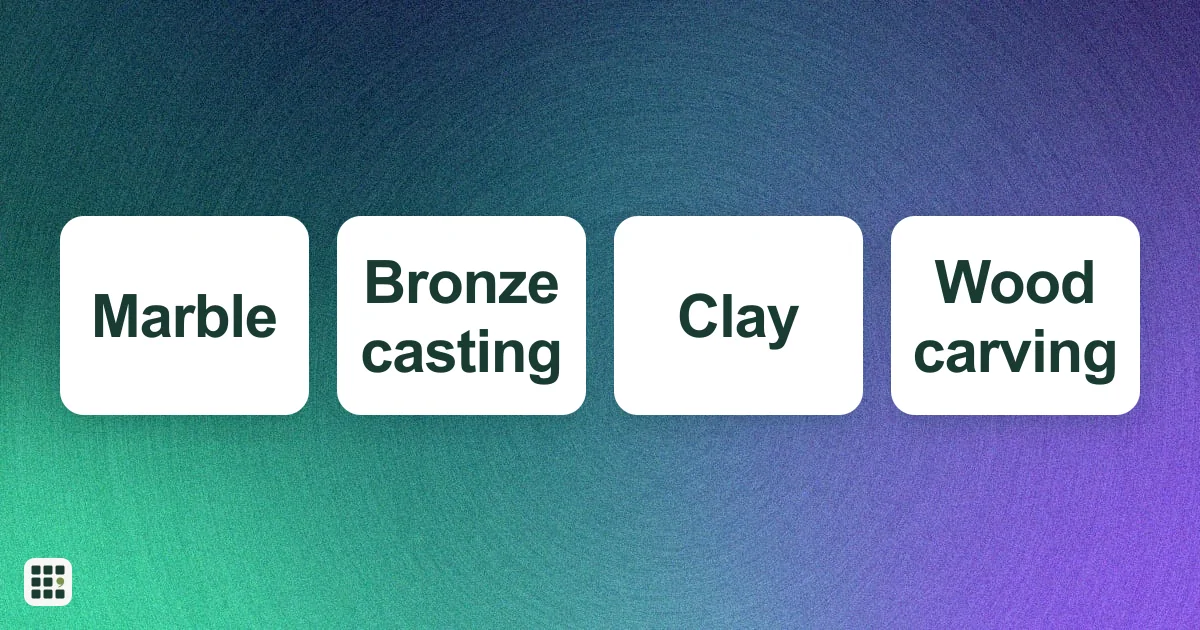
Sculpture materials and techniques
Marble, bronze, clay, wood, glass, plaster, paper and more, compared by how each is worked, how long it lasts, whether it can live outdoors, what it costs and how much skill it takes.
Last updated
How to choose
Start with where the piece will live and how long it must last. Outdoor display rules out plaster, wax, paper and unsealed clay; indoor-only work can use almost anything.
Decide how you like to work
- Carving (marble, stone, wood) removes material, so a mistake cannot be undone. Plan before you cut.
- Modelling (clay, wax, plaster) builds up material and is easy to correct, which suits beginners.
- Casting (bronze, plaster, glass) turns a model into a durable copy, but usually needs a foundry or kiln.
- Assembling (welded steel, found objects, paper, 3D printing) joins parts together.
Check the full cost
Material is often the smaller part. Bronze casting is billed by a foundry, and welding or glass needs equipment, ventilation and safety training. Budget for tools and space as well as stock.
Match skill to ambition
Begin with a forgiving material such as clay, wax, plaster or wood, learn proportion and form, then move on to harder ones.
Answer
Browse the table. Filter to what matters.
Use the filters below, then sign in if you want to shortlist and decide with friends.
Sign in to vote, hide services and features, and reorder.
Verified: hover a cell and click its green dot for the source Estimate: no cited source
| Feature | ⠿ | ⠿ | ⠿ | ⠿ | ⠿ | ⠿ | ⠿ | ⠿ | ⠿ | ⠿ | ⠿ | ⠿ |
|---|---|---|---|---|---|---|---|---|---|---|---|---|
|
⠿
Process
|
Assembling: a printer builds layers from a digital model
|
Assembling: cut, fold and glue sheets
|
||||||||||
|
⠿
Key tools
|
Point and claw chisels, mallet, rasps, abrasives
|
Foundry furnace, crucible, wax model, ceramic shell
|
Hands, wooden tools, wire loops, kiln
|
Knives, gouges, mallet, saw
|
Hammer, chisels, rasps; soapstone needs only files
|
Welder, grinder, clamps, safety gear
|
Mixing bucket, moulds, rasps, wire
|
Warm hands, sculpting tools, heat source
|
Furnace or kiln, blowpipe, moulds
|
3D printer, modelling and slicer software
|
Craft knife, scissors, glue, cutting mat
|
Glue, bolts, drill; depends on the objects
|
|
⠿
Durability
|
High; rusts unless coated
|
High, but brittle
|
Medium; plastics yellow and crack in sun
|
Low; weakens with damp and age
|
Varies with the objects used
|
|||||||
|
⠿
Outdoor suitability
|
Excellent; develops a protective patina
|
Good if fired and frost-proof; unfired clay dissolves
|
Good with coating; weathering steel suits outdoors
|
Poor; crumbles in rain unless sealed
|
Poor; melts in heat
|
Fair; impact or freezing can crack it
|
Fair with UV-stable filament such as ASA
|
Poor; indoor use only
|
Varies; metal outlasts plastic or paper
|
|||
|
⠿
Starting cost
|
$300
|
$1,500
|
$40
|
$30
|
$60
|
$400
|
$25
|
$20
|
$200
|
$250
|
$15
|
$20
|
|
⠿
Skill needed
|
High; mistakes cannot be undone
|
Very high; usually done by a foundry
|
Low to medium; hand-building suits beginners
|
Medium; soft stones suit beginners
|
Medium to high; safety training needed
|
Low; forgiving for beginners
|
Low; easy to reshape
|
Low to medium; needs 3D modelling
|
Low; good for beginners
|
Low; the idea matters more than technique
|
||
|
⠿
Famous examples
|
Michelangelo's David; Venus de Milo
|
Great Sphinx of Giza; Mount Rushmore
|
Models for lost-wax bronzes
|
Dale Chihuly's blown glass
|
Art toys, prototypes, maquettes
|
Origami; papier-mache figures
|
Why these features matter
-
Process
Carving cannot be undone, while modelling can be corrected. This is the biggest difference in how it feels to work.
-
Key tools
Specialist equipment such as a kiln or welder adds cost, space and safety needs.
-
Durability
If you want an heirloom or a public work, durability matters most; for practice or models it matters little.
-
Outdoor suitability
Rain, frost and sun destroy some materials in a few seasons.
-
Starting cost ($)
Cost varies by a factor of a hundred between paper and bronze.
-
Skill needed
Pick a forgiving material first so early mistakes do not put you off.
-
Famous examples
Seeing what the material can do helps you judge what you want to make.
About the services
-
Marble
Fine-grained stone carved with chisels. Prized for a smooth, luminous finish; unforgiving of mistakes and heavy.
-
Bronze casting
A model is cast in molten bronze, usually by lost-wax casting at a foundry. Very durable and detailed, but costly.
-
Clay and ceramics
Soft clay is modelled by hand and usually fired in a kiln. Cheap and forgiving to start with.
-
Wood carving
Shaping a block of wood with knives and gouges. Easier to work than stone, but weathers badly outdoors.
-
Stone carving
Carving limestone, sandstone, granite or soft soapstone. Soft stones suit beginners; hard stones need strong tools.
-
Welded steel
Steel pieces cut, forged and welded into a form. Strong and large-scale, but needs equipment and safety training.
-
Plaster
Poured into moulds or built up over a frame. Cheap, quick and good for models, but fragile and poor outdoors.
-
Wax
Soft and easy to reshape; mainly used for models before casting in metal rather than for lasting works.
-
Glass
Blown, cast in a kiln or fused. Striking light effects, but needs specialist equipment and is brittle.
-
3D printing
A printer builds a digital model layer by layer in plastic or resin. Good for precise, repeatable shapes.
-
Paper and cardboard
Cut, folded and glued sheets. Very cheap and easy to start, but delicate and indoor-only.
-
Found-object assemblage
Everyday or discarded objects joined into a new work. Low cost; the idea matters more than technique.
Suggest a change
Related comparisons
-
 Printmaking techniques
Printmaking turns one design into a set of prints. The techniques differ in how the image is made on the plate or block, which tools and equipment you need, how many good prints you can pull, what the lines look like, and what it costs to start. This grid compares twelve techniques so you can match one to your budget, space, and the look you want.
-
 Pottery and ceramic types
Earthenware, stoneware, porcelain, raku and other pottery types compared by firing temperature, strength, food safety, look and how hard they are for a beginner to work with.
-
 Gardening and landscape design styles
English cottage, French formal, Italian, Japanese, Zen, Mediterranean, modern, prairie, xeriscape, tropical, woodland, Persian and Chinese scholar gardens, compared by origin, plants, layout, upkeep, water needs and climate.
-
 Painting styles and art movements
A side-by-side guide to seventeen major Western painting movements, from the Renaissance to Photorealism. Compare when and where each began, what it reacted against, its key artists, its look and mood, and where to see it in person. Movements overlap and blur, so dates are approximate.
-
 Kids activity subscription boxes
Compare children’s mailed activity and play kits by age range, recurring price, delivery schedule, what arrives, US shipping, and how to stop renewal. The options span developmental play, STEAM, geography, cooking and coding.
-
 Cooking classes in Rome, Italy
A cooking class is one of the most enjoyable ways to spend an afternoon in Rome: roll fettuccine and ravioli in Trastevere, make tiramisu by the Vatican walls, shop Campo de' Fiori before cooking a full Roman meal, or join residents at an Italian-language cooking school. This grid compares public cooking classes across the city provider by provider: what they teach, what a place really costs in euros, how long classes last, the teaching language, group size, whether you get a meal and wine, and the rules on age, booking, cancellation and dietary needs. Visitor classes are taught in English and end with a meal; residents' schools are in Italian, cheaper per hour of teaching, and end with a tasting.