



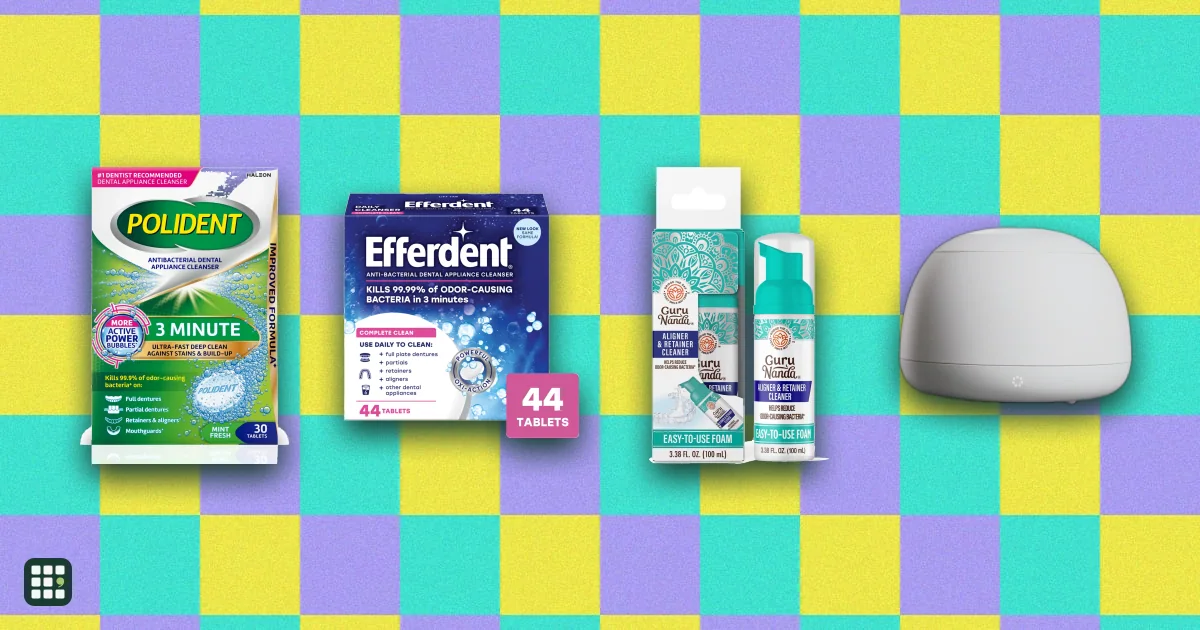
Retainer and denture cleaners
Retainers, aligners, night guards and dentures collect plaque, stain and odor-causing bacteria and need cleaning every day. This grid compares 9 cleaners you can buy in the US: effervescent tablets from Polident, Efferdent, Equate and M3 Naturals; a no-soak foam; and ultrasonic cleaners from GuruNanda and Zima. The decision comes down to what you are cleaning, how much time you have, cost per use, and whether you want to buy a device once or tablets again and again.
Last updated
How to choose
Start with what you are cleaning, because makers differ on which appliances they name. Always follow the instructions on the package, use lukewarm or warm water as directed (never hot, which can warp plastic), and rinse the appliance before putting it back in your mouth. Ask your dentist or orthodontist if you are unsure what your appliance can take.
Pick a type
- Tablets (Polident, Efferdent, Equate, M3 Naturals) are the cheapest way to start: a few dollars a box, dropped into a cup of warm water. Most need a few minutes; some are made for an overnight soak.
- Foam (GuruNanda) needs no cup or soak: you apply, spread and rinse. It suits travel and quick daily cleaning.
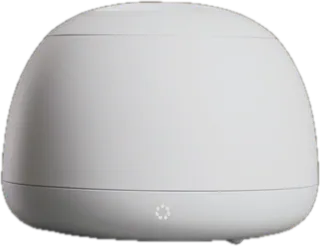
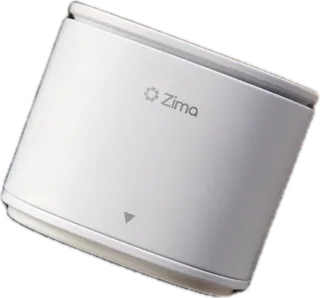
- Ultrasonic cleaners (GuruNanda, Zima) use sound waves in a water tank to loosen debris from grooves. They cost $30 to $160 once, and some makers sell or bundle their own tablets.
Check these before buying
- Named appliances: check that the maker names dentures, retainers and aligners, or night guards, whichever you wear. The grid shows only what each maker states.
- Cost per use: divide the tablet price by the count. A 30 count box and a 44 count box are priced alike here, but cost more or less per cleaning.
- Overnight soak: if you soak dentures overnight, choose a tablet whose maker says that is safe.
- Claims: bacteria-kill percentages and stain-removal claims come from the makers' own testing, not independent labs.
Prices change, so confirm at the store. Replace any appliance that becomes cracked or cloudy no matter how it is cleaned.
Answer
Browse the table. Filter to what matters.
Use the filters below, then sign in if you want to shortlist and decide with friends.
Sign in to vote, hide products and features, and reorder.
Verified: hover a cell and click its green dot for the source Estimate: no cited source Not stated: the maker doesn't publish it
| Feature | ⠿ | ⠿ | ⠿ | ⠿ | ⠿ | ⠿ | ⠿ | ⠿ | ⠿ |
|---|---|---|---|---|---|---|---|---|---|
|
⠿
Price
|
|||||||||
|
⠿
Type
|
|||||||||
|
⠿
Package size
|
|||||||||
|
⠿
Uses per package
|
Doesn't apply
|
Doesn't apply
|
Doesn't apply
|
||||||
|
⠿
Works on dentures
|
|||||||||
|
⠿
Works on retainers and aligners
|
|||||||||
|
⠿
Works on night guards
|
|||||||||
|
⠿
Cleaning time
|
|||||||||
|
⠿
Overnight soak
|
Doesn't apply
|
Doesn't apply
|
Doesn't apply
|
Doesn't apply
|
|||||
|
⠿
Bacteria kill claim
|
|||||||||
|
⠿
Stain removal
|
|||||||||
|
⠿
Cleaning method
|
Why these features matter
-
Price ($)
Tablets cost a few dollars a box and are used up; ultrasonic cleaners cost $30 to $160 once. Compare cost per use, not shelf price.
-
Type
Tablets are cheap and need a cup; foam needs no soak; an ultrasonic device cleans without chemicals alone but costs more up front.
-
Package size
A 30 count box lasts a month of daily soaks; an 84 count pack lasts nearly three months.
-
Uses per package (uses)
Divide the price by the number of uses to compare tablets honestly.
-
Works on dentures
Denture wearers need a cleaner the maker says is safe for dentures; some retainer products are not.
-
Works on retainers and aligners
Clear aligners and retainers scratch and cloud easily, so use only a cleaner made for them and no hot water.
-
Works on night guards
Night guards collect bacteria like retainers do; check that the product names them.
-
Cleaning time
A 3 minute soak fits a morning routine; overnight tablets fit when you take dentures out at bedtime.
-
Overnight soak
Dentures are often soaked overnight; not every tablet is meant for that.
-
Bacteria kill claim (%)
Odor comes from bacteria, so a lower claim is not necessarily worse; the figures are maker claims, not independent tests.
-
Stain removal
Coffee, tea and tobacco stain appliances; check the claim if staining is your problem.
-
Cleaning method
Chemical soaks, foam and ultrasonic waves clean differently; ultrasonic cleaners reach grooves a brush cannot.
About the products
-
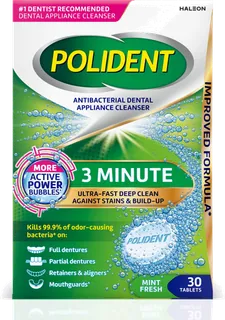
Polident 3 Minute Antibacterial Cleanser Tablets · Polident
Effervescent tablets for daily 3 to 5 minute soaks of dentures, retainers, aligners and mouthguards; the least expensive per use here.
-
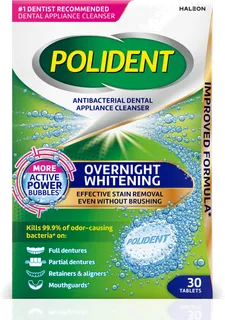
Polident Overnight Whitening Cleanser Tablets · Polident
Overnight soak tablets that the maker says remove stains without brushing; safe for dentures, retainers, aligners and mouthguards.
-
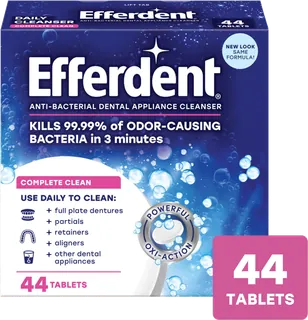
Efferdent Complete Clean Cleanser Tablets · Efferdent
Oxygen-releasing tablets with a 3 minute soak for dentures, plastic retainers and aligners, in a 44 count box.
-
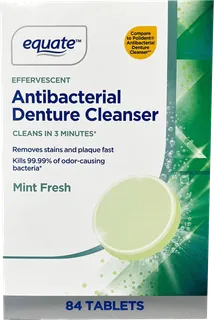
Mint Fresh Denture Cleanser Tablets · Equate
Walmart's store-brand dual-layer tablets; an 84 count pack that the maker says can soak full dentures overnight.
-
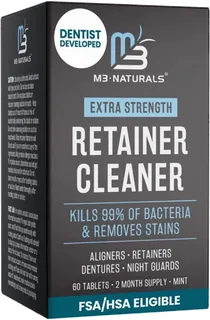
Retainer Cleanser Tablets · M3 Naturals
Extra-strength tablets sold individually wrapped, for aligners, retainers, dentures and night guards; the most expensive tablets here.
-
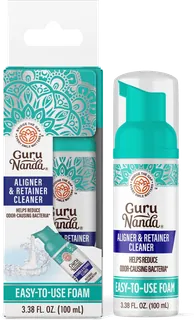
Aligner and Retainer Cleaner Foam · GuruNanda
No-soak foam you apply, spread and rinse off, with no toothbrush; for aligners, retainers and mouthguards on the go.
-
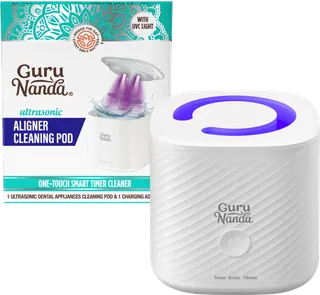
Retainer and Aligner Cleaning Pod · GuruNanda
Ultrasonic cleaner with a UV light mode, 3 cleaning modes and a 190 ml tank; the lowest-priced ultrasonic device here.
-
Dental Pod Pro · Zima Dental
Premium ultrasonic cleaner with a detachable 190 ml tank and a 15 minute max clean mode; 1-year warranty.
-
Dental Pod Go · Zima Dental
Travel-friendly ultrasonic cleaner with a rechargeable base and 3 minute cycle; for aligners, retainers, dentures and mouth guards.
Suggest a change
Related comparisons
-
 Toothpaste tablets and zero-waste oral care
Toothpaste tablets swap the tube for a small dry tablet: you chew one, brush with a wet toothbrush, and it foams into paste. They suit travel, plastic-free routines and people who dislike tubes, but they differ on the things that matter for teeth: some contain fluoride, others use nano-hydroxyapatite; some ship in compostable pouches with a refillable jar; and monthly cost varies a lot. This grid compares the main tablets sold to US buyers with the ingredients, packaging and prices the makers publish.
-
 Teeth whitening toothpastes
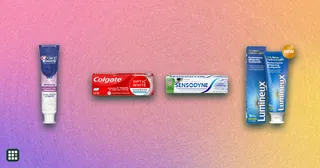
Whitening toothpastes remove surface stains with polishing abrasives, baking soda, or a peroxide, and a few add ingredients such as hydroxyapatite or a purple color corrector. None changes the natural color of teeth the way strips or in-office whitening can. This grid compares them on price per ounce, whitening method, peroxide, fluoride, sensitivity, SLS, and the American Dental Association Seal.
-
 Toothpastes for sensitive teeth
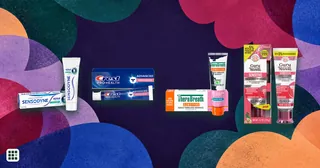
Sensitivity toothpastes are for teeth that ache from cold, heat, sweets, or touch. Most work by building up protection over a few weeks of twice-daily brushing, using 5% potassium nitrate, stannous fluoride, or hydroxyapatite. This grid compares them on price per ounce, the active ingredient, fluoride, gum protection, whitening claims, SLS, and the American Dental Association Seal. If sensitivity is severe or lasts more than a few weeks, see a dentist.
-
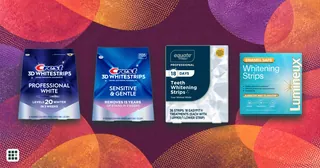 Teeth whitening strips
 are thin, gel-coated strips you wear for 30 to 60 minutes a day for one to three weeks. This grid compares Crest's Whitestrips range with store-brand, peroxide-free, and dentist-brand strips on price per treatment, wear time, whitening agent, sensitivity, and the American Dental Association Seal. The main trade-off: stronger and longer courses cost more and are more likely to cause temporary sensitivity, while gentler or peroxide-free strips are slower.
-
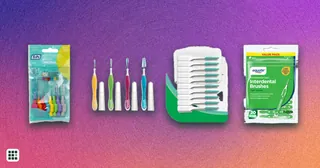 Interdental brushes
 clean the gaps between teeth where a toothbrush cannot reach, and many dentists suggest them for gum care, braces, bridges and implants. This grid compares ten widely sold US options, from TePe and Curaprox wire brushes to GUM, DenTek and Equate drugstore brushes and soft rubber picks. The real trade-offs are fit (a brush that is too big hurts and one that is too small does little), price per brush, and whether you want a reusable wire brush or a disposable rubber pick.
-
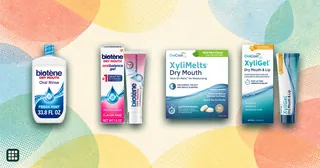 Dry mouth products (xylitol lozenges, sprays, rinses)
Dry mouth (xerostomia) can come from medications, medical conditions, aging or sleeping with your mouth open, and it makes the mouth sticky, uncomfortable and more prone to cavities and bad breath. This grid compares 14 over-the-counter dry mouth products you can buy in the US: rinses, sprays, gels, xylitol lozenges and mints, gum and adhering discs. The real choice is how you want to use it (at home, on the go, or overnight), how long it lasts, whether it has fluoride or xylitol, and what it costs per package.