



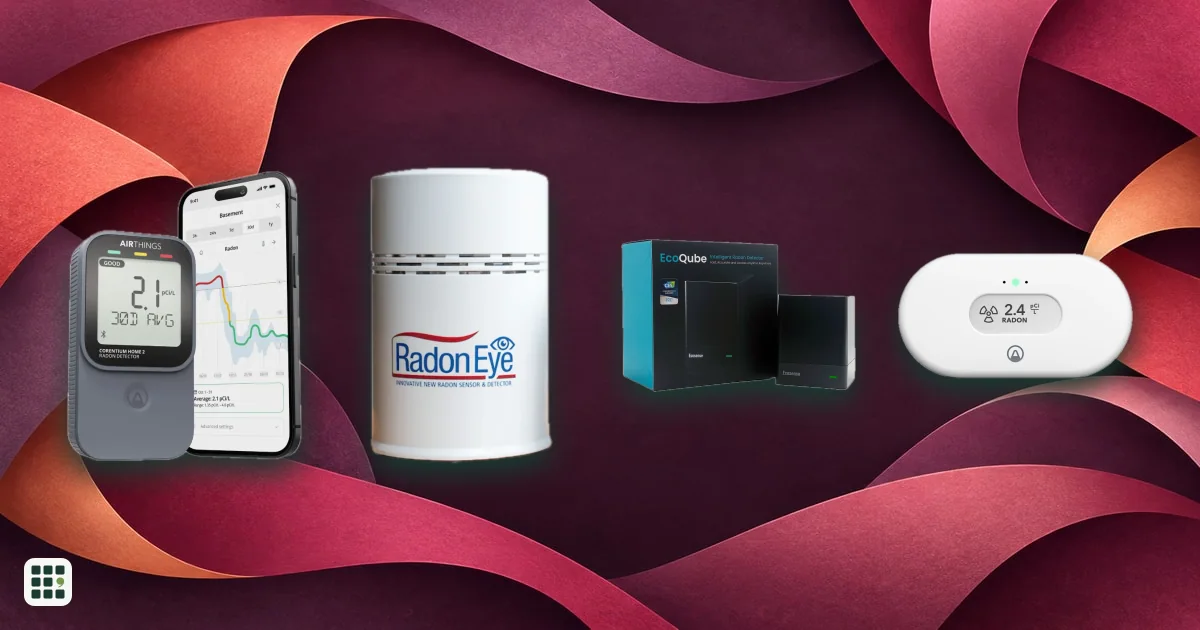
Radon detectors
Radon is an odorless radioactive gas that seeps up from the ground and is the leading cause of lung cancer among non-smokers. A continuous radon detector (or radon monitor) measures it day after day, so you see your real long-term average instead of one short test. The main choices: how quickly readings settle, whether there's a screen, battery or plug-in power, Wi-Fi or Bluetooth, extra air quality sensors, and whether anyone independent has checked the accuracy.
Last updated
How to choose
A monitor answers two questions a one-off test kit can't: what your long-term average radon level is, and whether a fix (sealing cracks, a mitigation fan) is still working months later. The US EPA recommends fixing a home at or above 4 pCi/L and considering it between 2 and 4 pCi/L, based on the long-term average, not one day's reading.
Decide where it will live
- Place it in the lowest level you actually use: a basement bedroom, playroom or home office, not an unused crawl space.
- Battery models go anywhere and move easily between rooms; plug-in models need an outlet but never need new batteries.
Rule out deal-breakers
- Independent accuracy: cheap no-name radon meters have been recalled in Canada for failing accuracy tests. Check the C-NRPP row: approved models passed independent chamber testing.
- Remote access: if you need alerts while away (a rental, a second home), choose built-in Wi-Fi or a model that works with a hub. Bluetooth-only units sync only when your phone is nearby.
- No screen: light-only models need the app to show a number.
Compare the key features
- Time to first reading: pulsed ionization chambers show a number in about 10 minutes to an hour; diffusion sensors take about a day. Either way, treat the first days as provisional.
- Averages shown: a long-term average on the screen or app is the figure to act on.
- Extra sensors: CO2, VOC and fine-dust sensors make sense for a living room; for a basement, radon plus humidity is usually enough.
Judge the claims
Makers state accuracy at different radon levels and test lengths, so a smaller percentage isn't automatically better. Ignore any claim of a trustworthy result in minutes: radon swings with weather and season, so leave a monitor in place for at least 90 days, ideally through the heating season.
Check the final choice
Confirm the US model and its price, whether remote access needs a hub sold separately, the battery life, and the warranty. If a sale or purchase deadline needs a formal result, use a certified radon tester or a lab-analyzed test kit as well.
Answer
Browse the table. Filter to what matters.
Use the filters below, then sign in if you want to shortlist and decide with friends.
Sign in to vote, hide products and features, and reorder.
Verified: hover a cell and click its green dot for the source Estimate: no cited source Not stated: the maker doesn't publish it
| Feature | ⠿ | ⠿ | ⠿ | ⠿ | ⠿ | ⠿ | ⠿ | ⠿ | ⠿ | ⠿ | ⠿ | ⠿ | ⠿ | ⠿ |
|---|---|---|---|---|---|---|---|---|---|---|---|---|---|---|
|
⠿
Price
|
||||||||||||||
|
⠿
C NRPP approved
|
|
|
|
|
|
|
|
|||||||
|
⠿
Radon sensor type
|
||||||||||||||
|
⠿
Time to first reading
|
60 min
|
60 min
|
60 min
|
60 min
|
||||||||||
|
⠿
Reading update interval
|
10 min
|
60 min
|
60 min
|
|||||||||||
|
⠿
Sensitivity
|
||||||||||||||
|
⠿
Stated accuracy
|
||||||||||||||
|
⠿
Measurement range max
|
213 pCi/L
|
|||||||||||||
|
⠿
Screen
|
||||||||||||||
|
⠿
Averages shown
|
||||||||||||||
|
⠿
Audible alarm
|
|
|
|
|
|
|||||||||
|
⠿
WiFi
|
|
|||||||||||||
|
⠿
Bluetooth
|
|
|
||||||||||||
|
⠿
Phone app
|
|
|||||||||||||
|
⠿
Remote access
|
None
|
None
|
None
|
|||||||||||
|
⠿
Smart home integrations
|
Alexa, Google Home, IFTTT, Homey (with hub)
|
None
|
None
|
None
|
None
|
Home Assistant
|
Home Assistant
|
None
|
||||||
|
⠿
Data export
|
|
|||||||||||||
|
⠿
Power source
|
||||||||||||||
|
⠿
Battery life
|
Doesn't apply
|
Doesn't apply
|
Doesn't apply
|
Doesn't apply
|
Doesn't apply
|
|||||||||
|
⠿
Temperature
|
|
|
|
|
|
|
|
|||||||
|
⠿
Humidity
|
|
|
|
|
|
|
|
|||||||
|
⠿
Carbon dioxide
|
|
|
|
|
|
|
|
|
||||||
|
⠿
VOCs
|
|
|
|
|
|
|
|
|
||||||
|
⠿
Fine dust PM2 5
|
|
|
|
|
|
|
|
|
||||||
|
⠿
Air pressure
|
|
|
|
|
|
|
|
|||||||
|
⠿
Subscription required
|
|
|
|
|
||||||||||
|
⠿
Warranty
|
2 years
|
|||||||||||||
|
⠿
Weight
|
||||||||||||||
|
⠿
Release year
|
2019
|
2025
|

Why these features matter
-
Price ($)
The upfront cost. A monitor runs for years, so compare it with buying repeat test kits ($15 to $75 each).
-
C NRPP approved
C-NRPP tests consumer radon monitors in a reference chamber; it is the only independent public accuracy check for this category. Untested doesn't mean inaccurate, just unproven.
-
Radon sensor type
Ionization chambers count more decays per hour, so readings settle within hours; diffusion-photodiode sensors need a day or more before the first number. Both can be accurate over weeks.
- Ionization chamber
- : Counts radon decays inside a charged chamber. Gives a usable number within minutes to an hour and settles fast after changes.
- Passive diffusion
- : Air seeps into a chamber where a light sensor counts decays. Slower to give a first number (an hour to a day), but just as useful for long-term averages.
- Solid-state
- : A silicon detector; the maker gives few details about how it measures.
-
Time to first reading (min)
Matters if you want a quick look, for example right after a mitigation fan is installed. For your health decision, the 90-day average is what counts, so speed matters less.
-
Reading update interval (min)
Frequent updates show daily swings and how fast a fix works. A slower update is fine if you only care about the long-term average.
-
Sensitivity (cph/pCi/L)
More counts per hour means less statistical noise, so short-term readings are more trustworthy. It matters most for checking hour-to-hour changes.
-
Stated accuracy
Claims are stated at different radon levels and test lengths, so they aren't directly comparable; the C-NRPP row is the independent check.
- ±5% long term
- : The maker claims ±5% once the monitor has run for about two months, which is when its average is most trustworthy.
- Within 10 hours
- : The maker claims its accuracy figure after only 10 hours of running, thanks to a fast ionization chamber.
-
Measurement range max (pCi/L)
Most homes are far below 100 pCi/L, so this matters only in very high radon areas or for checking a crawl space.
-
Screen
A screen lets anyone in the house check the level at a glance without an app. Light-only models need the app for numbers.
- E-ink
- : A paper-like screen that stays visible without power drain, so battery models can show readings all the time.
- No numeric screen
- : Only a colored light on the device; you need the app to see the actual radon number.
-
Averages shown
The EPA bases its action level on the long-term average, so a monitor that shows a long-term figure answers the real question directly.
- Long-term
- : An average since you started measuring (up to a year). This is the figure the EPA action level is based on.
-
Audible alarm
Useful if nobody checks an app; less important for a monitor you read weekly.
-
WiFi
Wi-Fi gives remote readings and alerts when you're away, for example in a rental or a second home.
-
Bluetooth
Bluetooth syncs readings to your phone when you're nearby, with no network setup.
-
Phone app
An app keeps the history and charts that a small screen can't, which is how you see seasonal changes.
-
Remote access
Without remote access you only see readings when you're near the device.
- With a hub
- : Readings reach your phone away from home only if you also own an Airthings Hub or a plugged-in View monitor.
-
Smart home integrations
Integrations can switch on a fan or send an alert from another system when radon rises.
- IFTTT
- : A free automation service: for example, switch on a smart plug for a fan when radon rises.
- Home Assistant
- : Open-source home automation you run yourself; good for logging and automations if you already use it.
-
Data export
Useful for sharing proof of levels with a mitigation contractor, landlord, or buyer.
-
Power source
Battery units go anywhere, including rooms with no free outlet; plug-in units never need new batteries.
-
Battery life (years)
Longer battery life means fewer swaps and fewer gaps in your long-term average.
-
Temperature
A small extra; helps explain radon swings with heating and cooling.
-
Humidity
Handy in basements, where damp and mold are a common second concern.
-
Carbon dioxide
CO2 shows how well a room is ventilated, which also affects radon buildup. Skip it if you only care about radon.
-
VOCs
Flags fumes from paint, cleaners, and new furniture; a radon-only buyer doesn't need it.
-
Fine dust PM2 5
Tracks smoke and cooking dust in living areas; rarely needed in a basement.
-
Air pressure
Radon often rises when outdoor pressure drops, so pressure helps explain spikes.
-
Subscription required
A required plan adds to the real cost over years.
-
Warranty (years)
Monitors run for years; a longer warranty covers sensor failures.
-
Weight (g)
Matters only if you'll move the monitor between rooms or homes.
-
Release year
Newer models usually get app updates for longer.
About the products
-
Corentium Home 2 · Airthings
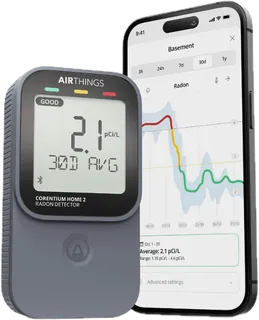
Battery radon monitor with an LCD that shows 24-hour, 7-day, 30-day and long-term averages, plus temperature and humidity. Syncs by Bluetooth; remote access needs an Airthings hub or View monitor. The first reading takes a day.
-
Corentium Home · Airthings · Superseded
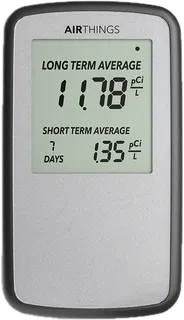
Airthings' original battery radon detector (2011): an LCD with short- and long-term averages and no app or wireless at all. Still sold, and still the cheapest Airthings radon monitor.
-
RadonEye RD200 · Ecosense
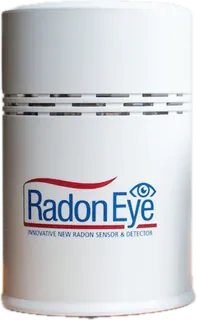
Plug-in radon monitor with a fast pulsed ionization chamber: first reading in about 10 minutes, a small OLED screen and an audible alarm. Bluetooth only, so history syncs when your phone is nearby.
-
EcoQube · Ecosense
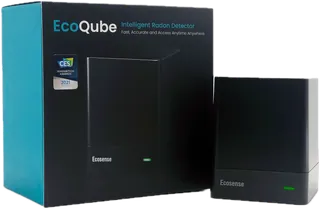
Plug-in Wi-Fi radon monitor with the same fast ionization chamber as the RadonEye, read remotely in the app with IFTTT support. It has no numeric screen: the front shows a colored status light.
-
EcoQube Flex · Ecosense
Battery radon monitor (2 AA) with an always-on e-ink screen and the fast ionization chamber, so it can move room to room. Bluetooth only, no remote access; launched December 2025.
-
EcoBlu · Ecosense
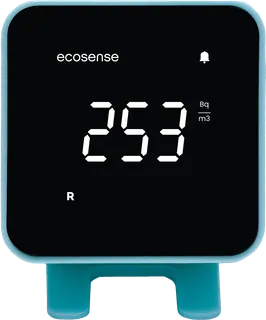
The cheapest monitor here: a plug-in radon display with an alarm and no app, Wi-Fi or Bluetooth. Good for someone who just wants a number on the wall.
-
Aranet Radon Plus · Aranet
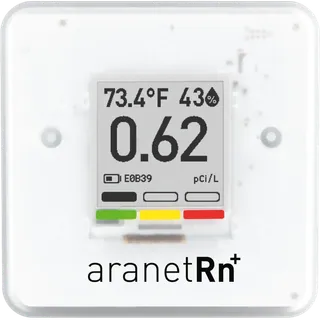
Battery radon monitor with an ionization chamber, e-ink screen, and temperature, humidity and pressure sensors; first reading in 10 minutes and years of battery life. Bluetooth only. Aranet's US store sells it in bundles; the price shown is Amazon's.
-
Aranet Radon One · Aranet
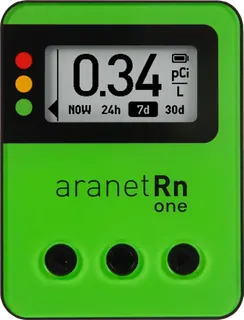
Aranet's radon-only, lower-priced monitor: ionization chamber, e-ink screen, AA batteries, Bluetooth app. Lower measurement ceiling than the Radon Plus; the price shown is from Amazon US.
-
View Radon · Airthings
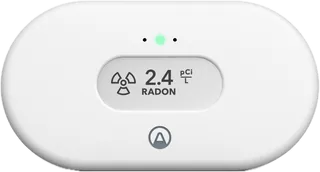
Wi-Fi radon monitor with an e-paper screen, temperature and humidity, and remote readings without a hub. Runs on 6 AA batteries or USB.
-
Wave Radon · Airthings · No longer sold
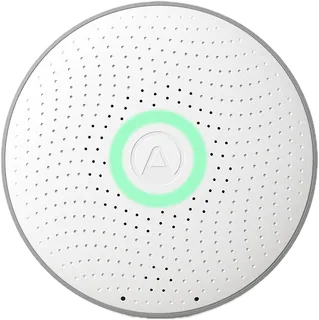
Battery Bluetooth radon monitor with a color glow ring instead of a screen, plus temperature and humidity. No longer sold on airthings.com, which points buyers to the View Radon; still found at some retailers.
-
Wave Plus · Airthings
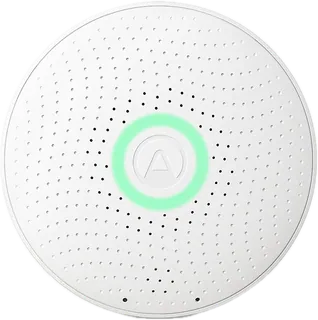
Battery radon and air quality monitor (CO2, VOCs, temperature, humidity, pressure) with a glow ring rather than a screen. Bluetooth; remote access needs a hub or a View monitor.
-
View Plus · Airthings
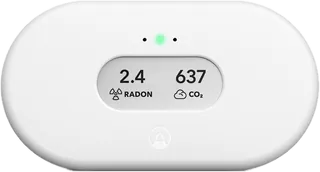
The most complete monitor here: radon plus fine dust, CO2, VOCs, temperature, humidity and pressure, an e-paper screen and Wi-Fi. Costs the most; best for a main living space.
-
lüft · SunRADON
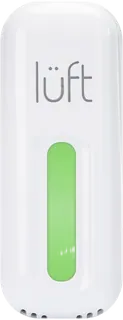
Plug-in Wi-Fi radon and air quality monitor (VOCs, CO2 estimate, temperature, humidity, pressure) from a maker of professional radon instruments. No numeric screen; a short 90-day warranty.
-
SafetySiren Pro4 · Family Safety Products
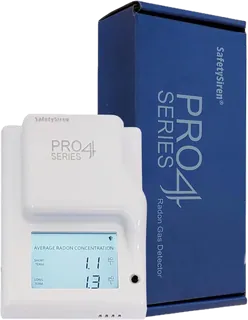
Plug-in radon detector with a backlit LCD and audible alarms, made in the USA, with no app or connectivity. The maker's own website is gone, so it's sold only through retailers.
Suggest a change
Related comparisons
-
 Air quality monitors
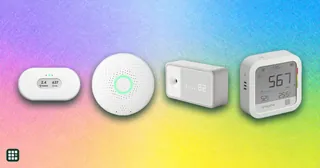
Indoor air quality monitors measure what you can't see or smell: CO2 that builds up in closed rooms, fine dust, chemical fumes and, on a few models, radon. They don't clean the air; they tell you when to open a window, run a purifier or test further. The real choice is which pollutants you need to track, and whether you want a screen, batteries, Wi-Fi, or a paid plan.
-
 Fire extinguishers
Home fire extinguishers differ mainly in their UL rating, whether they can be refilled, and whether they are meant for the kitchen, garage or whole house. This grid compares ratings, agent, weight, price and warranty across popular Kidde, First Alert and Amerex models.
-
 Dehumidifiers
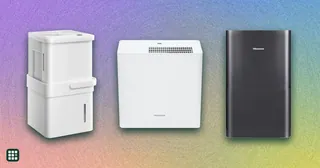
Compare portable dehumidifiers by water-removal rating, maker-stated room coverage, drainage, and warranty. A built-in pump can send water up to a sink or window drain, while gravity-drain models need the outlet below the unit; the maker's square-foot estimates vary and can conflict within a product page.
-
 Air purifiers
 pull dust, pollen, pet dander, smoke and odors out of the air in one room. The choice comes down to how big the room is, how loud the fan gets while you sleep, what the replacement filters cost each year, and whether you want app control or a plain dial.
-
 Ceiling fans
Compare ceiling fans from budget pull-chain models to quiet smart DC fans and large-room fans: price, blade span, airflow, efficiency, motor type, lights, controls, smart home support and wet or damp ratings. The real trade-offs are cost against quietness and efficiency (AC versus DC motors), the size of fan your room needs, and where it can safely go (indoors, a bathroom, or an open porch).
-
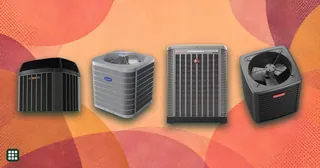 Central air conditioners
Compare current central split-system air conditioner condensers from Carrier, Trane, Lennox, Rheem, Ruud, American Standard, Bryant, Daikin, Goodman, Amana and York by matched-system efficiency, capacity, compressor type, refrigerant, sound, warranty, and controls. Ratings depend on the exact AHRI-certified indoor/outdoor match; listed maximums are not guaranteed for every match.