



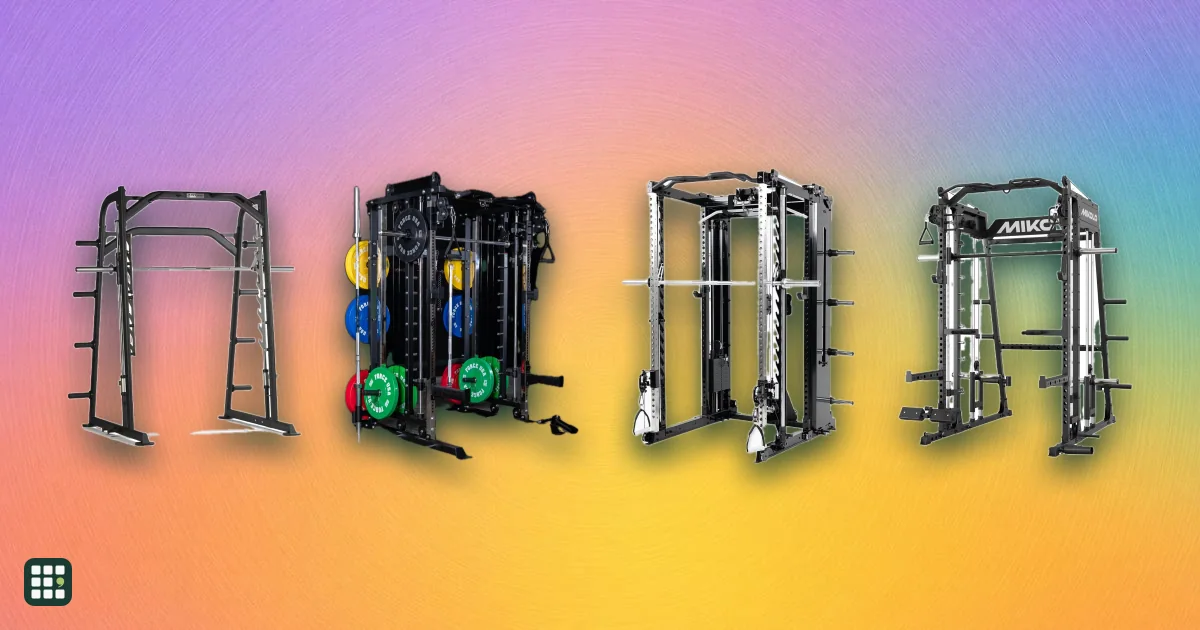
Smith machines
Smith machines guide a barbell on fixed rails so you can squat, press and lunge without a spotter. This grid compares stand-alone Smith machines, Smith machines with a half rack, and all-in-one racks with cables for home gyms, so you can see price, bar capacity, counterbalance, size and warranty side by side.
Last updated
How to choose
Decide how much machine you need
A stand-alone Smith machine is the simplest way to lift heavy without a spotter. An all-in-one adds cables, a pull-up bar and a landmine in one frame, which replaces several machines but needs more floor space and costs more. A Smith attachment on a rack lets you add features over time.
Check the bar
Look at the Smith bar rating, not just the rack rating, and at the starting weight. A counterbalanced bar feels lighter, which suits beginners, while a heavier bar feels closer to a free barbell. A slight angle can feel more natural for squats than a vertical track.
Measure your space
Compare height, width and depth against your room and ceiling, especially if you want to do pull-ups or overhead presses. Heavy machines are stable but hard to move, and freight delivery is often to the curb only.
Look past the price
Barbell, plates, bench and flooring are usually extra. Compare frame steel, warranty length and what comes in the box, such as J-hooks, a landmine or a lat pulldown bar.
Before you order
Check the exact model and what is included in your cart, the maker's Smith bar rating, and the warranty terms. Never exceed the rated loads.
Answer
Browse the table. Filter to what matters.
Use the filters below, then sign in if you want to shortlist and decide with friends.
Sign in to vote, hide products and features, and reorder.
Verified: hover a cell and click its green dot for the source Estimate: no cited source Not stated: the maker doesn't publish it
| Feature | ⠿ | ⠿ | ⠿ | ⠿ | ⠿ | ⠿ | ⠿ | ⠿ | ⠿ | ⠿ |
|---|---|---|---|---|---|---|---|---|---|---|
|
⠿
Price
|
$1,599.98
|
|||||||||
|
⠿
Configuration
|
Smith machine only
|
All-in-one with cables
|
All-in-one with cables
|
All-in-one with cables
|
All-in-one with cables
|
Rack with Smith attachment
|
Smith machine with plate-loaded cables
|
All-in-one with cables
|
All-in-one with cables
|
|
|
⠿
Smith bar capacity
|
||||||||||
|
⠿
Smith bar starting weight
|
||||||||||
|
⠿
Counterbalanced bar
|
|
|
|
|||||||
|
⠿
Bar path
|
Vertical
|
Vertical
|
Vertical
|
Vertical
|
Vertical
|
Vertical
|
Vertical
|
|||
|
⠿
Cable trainer
|
|
|
|
|||||||
|
⠿
Lat pulldown
|
|
|
|
|
||||||
|
⠿
Cable loading
|
Doesn't apply
|
Doesn't apply
|
Doesn't apply
|
|||||||
|
⠿
Pulley ratio
|
Doesn't apply
|
Doesn't apply
|
Doesn't apply
|
|||||||
|
⠿
Pull up bar
|
|
|||||||||
|
⠿
Free weight J hooks
|
||||||||||
|
⠿
Landmine
|
|
|
|
|||||||
|
⠿
Height
|
||||||||||
|
⠿
Width
|
||||||||||
|
⠿
Depth
|
||||||||||
|
⠿
Product weight
|
||||||||||
|
⠿
Frame steel
|
||||||||||
|
⠿
Frame warranty
|
Why these features matter
-
Price ($)
Price spans about $580 to $6,500 here. Decide how much of a rack, cables and attachments you want before comparing machines on cost alone.
-
Configuration
A stand-alone Smith machine is simplest. An all-in-one replaces a rack, a cable machine and a Smith machine in one footprint but costs more and needs more floor space.
-
Smith bar capacity (lb)
The bar rating caps how heavy you can squat or press. Under 450 lb is fine for beginners and moderate lifting; heavier lifters want 600 lb or more.
-
Smith bar starting weight (lb)
A lighter starting weight is easier for beginners; a heavier, barbell-like bar is better if you want the load to carry over to free barbell lifts.
-
Counterbalanced bar
A counterbalanced bar feels lighter and smoother on the way up, which helps beginners and high-rep work but changes the feel versus a free barbell.
-
Bar path
A slightly angled track can feel more natural for squats, but it needs more floor space. A vertical track is more compact and works for most presses.
- Vertical
- : The bar moves straight up and down. Compact and fine for presses; some lifters find squats less natural than on an angled track.
- Angled
- : The track leans a few degrees so your hips can travel back in a squat. Feels more natural for squats but needs more floor space.
-
Cable trainer
Cables add rows, curls, triceps and fly movements that a Smith bar alone cannot do. They cost more and take more space.
-
Lat pulldown
Pulldowns work the back without a pull-up bar, useful if you cannot do pull-ups yet.
-
Cable loading
Weight stacks change load quickly with a pin and are quiet; plate-loaded cables reuse plates you own but are slower to change.
- Plate-loaded
- : Cables lift the weight plates you already own. Cheaper, but changing the load is slower than a pin.
- Weight stack
- : A stack of plates you select with a pin. Quick to change and quiet, but adds cost and weight.
-
Pulley ratio
A 1:1 ratio gives more resistance per selected pound; 2:1 gives smoother, longer cable travel but half the handle resistance. Check this when comparing stack or plate loads.
-
Pull up bar
Pull-ups are one of the best back and arm exercises for a home gym; check ceiling height if you plan to use one.
-
Free weight J hooks
Lets you squat or bench with a regular barbell instead of the guided bar, useful if you also want free-weight lifting.
-
Landmine
A landmine allows rotational presses, rows and core work with one end of a barbell.
-
Height (in)
Compare against your ceiling, especially if you plan overhead presses or pull-ups.
-
Width (in)
Tells you how much wall space the machine needs.
-
Depth (in)
Depth decides whether the machine fits a one-car garage bay or a spare room.
-
Product weight (lb)
A heavier frame resists tipping under load; a lighter machine may need to be bolted down or weighed down with plates.
-
Frame steel
Heavier-gauge steel and larger uprights are more rigid and accept more attachments; 14-gauge 2x2 is common on budget machines.
- 11 gauge
- : Thicker, stiffer steel. Better for heavy loads and for attaching extras without flex.
- 14 gauge
- : Thinner steel than 11 gauge. Fine for typical home lifting; less rigid at the heaviest loads.
-
Frame warranty
A lifetime frame warranty is reassuring on a heavy purchase; one-year terms leave you carrying the risk after the first year.
About the products
-
Smith Machine · Titan Fitness
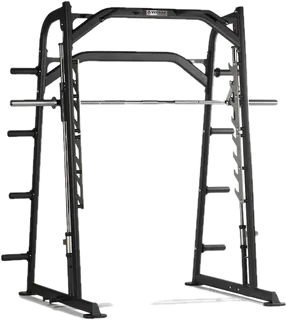
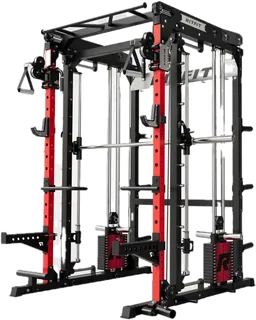
Stand-alone, counterbalanced Smith machine with linear bearings, J-hooks and a pull-up bar. No cables, so it suits lifters who want just the guided bar.
-
Series 7 Smith Machine GS348B · Body-Solid
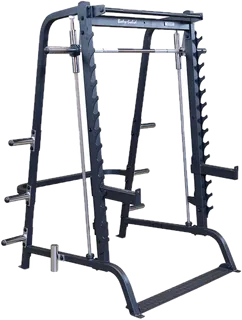
Commercial-rated Smith machine with a 7 degree angled bar path and a built-in half rack. Lat, pec and pull-up attachments are optional extras. Listed at $1,850 regular price with a $1,500 sale price on November 15, 2026; it replaces the GS348Q.
-
G3 All-In-One Trainer · Force USA
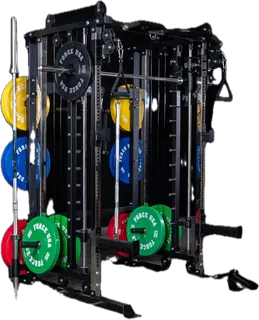
Plate-loaded rack with a Smith bar, functional trainer cables, chin-up bar and landmine. Often listed as sold out or on preorder.
-
G20 Pro All-In-One Trainer · Force USA
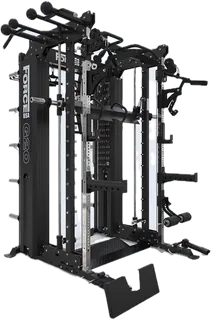
Force USA flagship: rack, Smith bar, dual weight-stack functional trainer, leg press, lat pulldown and low row. Large and expensive; for a dedicated home gym room.
-
SM-4033 Smith Machine Cage System · Marcy
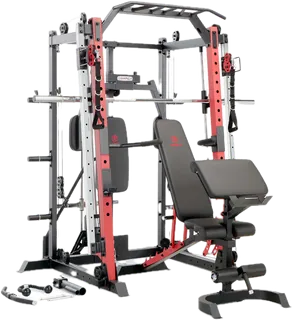
Budget-minded Smith cage with plate-loaded cable crossovers, pull-up bar, landmine and an adjustable bench. Every station is rated to 300 lb, well below dedicated Smith machines.
-
M4-2.0 Standard · Mikolo
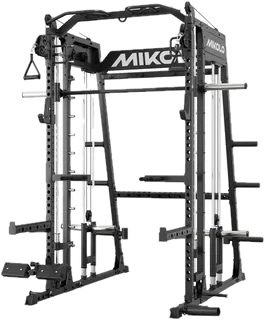
Plate-loaded Smith machine, rack and dual-pulley functional trainer in a compact frame, with a spring-assisted bar and an 800 lb Smith bar rating. Weight stacks are an optional upgrade.
-
Altitude Power Rack with Smith Machine · REP Fitness
Modular 2x2 inch rack with a bolt-on Smith attachment (400 lb rating, vertical bar, no counterbalance). Cables are a separate attachment, so price rises as you add on.
-
PSR05 Smith Machine · RitFit
Compact, low-priced Smith machine with a plate-loaded lat pulldown and low row, pull-up bar and landmine. Lowest Smith bar capacity and height of the grid, so it suits light to moderate lifting.
-
ALL10 Pro Smith Machine Functional Trainer · SNODE
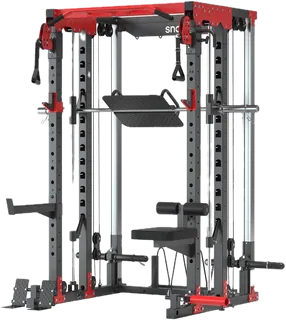
Compact plate-loaded rack with a Smith bar, dual 1:1 pulleys, hack squat and 13 attachments for about a thousand dollars less than the big-name all-in-ones. 14-gauge steel and a one-year warranty.
-
Heritage Series B17 Flying Fortress · Major Fitness
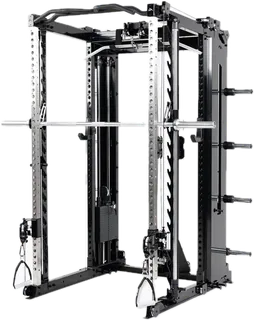
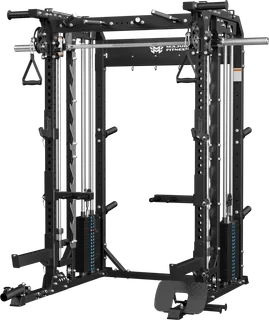
Premium rack with a linear-bearing Smith system, built-in dual weight stacks (130 lb per side, expandable) and 1:1 or 2:1 cable ratios. Highest weight and a one-year warranty.
Suggest a change
Related comparisons
-
 Weight benches
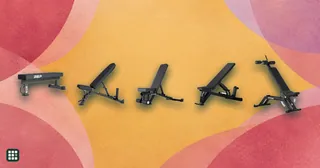
Flat and adjustable weight benches for home and garage gyms, from a fixed competition-style platform to benches with incline and decline positions. Compare current price, adjustment range, rated load, pad size, bench height and weight before deciding how much versatility and floor space you need.
-
 Rowing machines
Home rowing machines compared: the Concept2 RowErg and WaterRower classics, smart rowers from Hydrow, Ergatta, Aviron, Peloton, Echelon and NordicTrack, and budget magnetic and water rowers from Sunny, Merach and others. They differ in how resistance feels and sounds, whether you need a monthly membership, how much space they take and how they store, and how well they fit tall or heavy rowers.
-
 Kettlebells
 for swings, squats, presses, and get-ups at home: classic cast iron bells, competition bells that stay the same size at every weight, and adjustable kettlebells that replace a rack of bells. The choice comes down to how many weights you need, your budget per pound, and how the handle feels in your hands.
-
 Adjustable dumbbells
 pack a rack of fixed weights into one pair. The choice comes down to how heavy you need to go, how fast and in what steps the weight changes, how long the bells are in your hands, and whether they survive a drop. Plate-loaded and pin designs trade speed for toughness; dials and twist handles change in seconds but don't like being dropped.
-
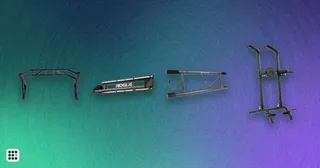 Pull-up bars
 for home training, from no-drill doorway bars for renters to permanent wall and ceiling bars and freestanding power towers. Compare price, how each one is mounted, rated capacity, grips and what it adds, so you pick the one your space and budget can actually hold.
-
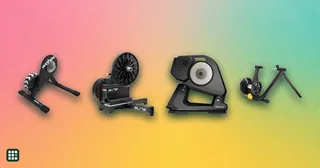 Indoor bike trainers
 turn your own bike into a stationary trainer for winter, bad weather or structured workouts. The big choices are direct drive versus wheel-on or rollers, smart (app-controlled resistance) versus classic, and how much realism, quietness and accuracy you want to pay for. This grid compares current models on bike fit, resistance, noise, app connectivity and full cost.