



FPV flight controller stacks
A flight controller stack pairs the brain of a quad (the flight controller) with a 4-in-1 ESC that drives its four motors. This grid compares current stacks for 3 to 7 inch FPV builds on processor, ESC current, battery voltage, mounting size and wireless setup, so you can match a stack to your frame, motors and battery.
Last updated
How to choose
Start with the frame and motors, because they fix the mounting size and the current you need.
Rule out the deal-breakers
- Mounting pattern. 20 x 20 mm fits small frames; 30.5 x 30.5 mm is the standard 5 inch size; 35 x 35 mm is for large builds. Many boards come with grommets for more than one screw size.
- Battery voltage. Check the ESC limit as well as the flight controller's. A 4-6S stack cannot run an 8S pack.
- ESC current. Pick continuous amps above what your motors draw at full throttle, with headroom. Burst ratings last only seconds, and makers use different durations.
Compare what changes your build
- Processor. F4 boards are fine for most 5 inch quads. F7 and H7 boards give more processing headroom and more serial ports for extras.
- ESC firmware. BLHeli_S is basic; BLHeli_32 and AM32 allow higher update rates and more settings.
- Bluetooth setup. Lets you adjust settings from a phone without a USB cable, useful on tight builds.
- Blackbox storage. Onboard flash is simple; a microSD slot holds more logs.
- Serial ports. Count what you need: receiver, video transmitter, GPS, and ESC telemetry.
Check the final choice
Confirm the board is still sold, that the firmware target is supported by the flight software you use, and that there is room for the ESC and its capacitor. Several stacks here are listed by their makers as discontinued or sold out, so check stock before planning a build around one.
Answer
Browse the table. Filter to what matters.
Use the filters below, then sign in if you want to shortlist and decide with friends.
Sign in to vote, hide products and features, and reorder.
Verified: hover a cell and click its green dot for the source Estimate: no cited source
| Feature | ⠿ | ⠿ | ⠿ | ⠿ | ⠿ | ⠿ | ⠿ | ⠿ | ⠿ |
|---|---|---|---|---|---|---|---|---|---|
|
⠿
Price
|
|||||||||
|
⠿
ESC continuous current
|
|||||||||
|
⠿
ESC burst current
|
|||||||||
|
⠿
Battery input
|
|||||||||
|
⠿
Mounting pattern
|
|||||||||
|
⠿
Flight controller MCU
|
STM32H743
|
||||||||
|
⠿
Gyro
|
|||||||||
|
⠿
ESC firmware
|
|||||||||
|
⠿
Bluetooth configuration
|
|
|
|
|
|||||
|
⠿
WiFi configuration
|
|
|
|
|
|
|
|||
|
⠿
UARTs
|
|||||||||
|
⠿
Blackbox storage
|
|||||||||
|
⠿
Barometer
|
|

Why these features matter
-
Price ($)
A stack is a big share of a build's cost; cheaper boards often give up processor or ESC power.
-
ESC continuous current (A)
Must exceed what your motors draw at full throttle. Bigger motors and higher cell counts need more.
-
ESC burst current (A)
Shows headroom for punch-outs and hard moves, but matters less than continuous current.
-
Battery input
Your battery must fall inside this range, or the stack can be damaged.
-
Mounting pattern
Must match your frame's stack holes; check grommets for screw size.
-
Flight controller MCU
H7 and F7 offer more processing headroom than F4, which helps with heavy filtering and more features.
-
Gyro
The ICM-42688 is lower noise than the older BMI270, and many pilots prefer it for tuning.
-
ESC firmware
BLHeli_32, AM32 and OX32 allow higher update rates and more settings than BLHeli_S.
-
Bluetooth configuration
Lets you tune without a USB cable, handy when the port is hard to reach.
-
WiFi configuration
Wi-Fi setup is rare on this class of board; Bluetooth is the usual wireless option.
-
UARTs (ports)
Each receiver, VTX, GPS or other add-on needs a port; some are already used by onboard features.
-
Blackbox storage
More storage holds more flight logs for tuning.
-
Barometer
Needed for altitude hold and some GPS rescue features.
About the products
-
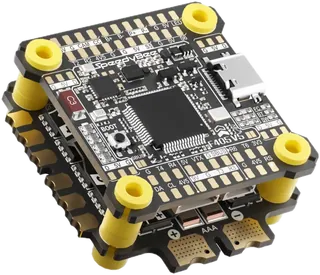
F405 V5 55A Stack · SpeedyBee · Discontinued
30.5 mm stack with an F405 flight controller, Bluetooth tuning and a 55A OX32 ESC with heat sink, aimed at 5 inch builds. SpeedyBee lists it as discontinued.
-
F405 V4 55A Stack · SpeedyBee · Discontinued
30.5 mm Bluetooth stack with a 6-pin DJI air unit plug, microSD blackbox and a 55A BLHeli_S ESC with heat sink. SpeedyBee lists it as discontinued.
-
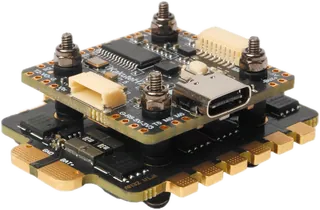
F405 Mini 35A Stack · SpeedyBee · Discontinued
Compact 20 x 20 mm Bluetooth stack with a 35A BLHeli_S ESC for 2 to 4 inch and light 5 inch quads. SpeedyBee lists it as discontinued.
-
F7 Mini 35A Stack · SpeedyBee · Discontinued
20 x 20 mm stack with an F7 processor, Bluetooth tuning and a 35A BLHeli_S ESC loaded with Bluejay, for small 2 to 4 inch quads. SpeedyBee lists it as discontinued.
-
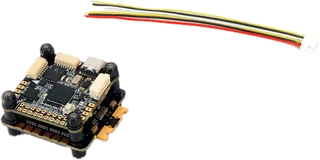
Kakute H7 V2 Stack (Tekko32 50A) · Holybro
30.5 mm H7 stack with Bluetooth, a plug for DJI and Vista, and a 50A BLHeli_32 ESC. A 65A metal ESC version and a VTX version are also offered. Variants showed as sold out when checked.
-
Kakute H7 Mini Stack (Tekko32 Mini 50A) · Holybro
20 x 20 mm H7 stack with a 50A AM32 ESC and onboard blackbox flash, for compact builds. A VTX version is also offered. Variants showed as sold out when checked.
-
Borg H7 Stack (60A) · iFlight
30.5 mm H7 stack for 5 to 10 inch builds with dual gyros, dual camera input and a 60A BLHeli_32 ESC.
-
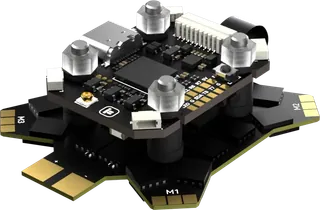
Borg Mini H7 Stack (60R) · iFlight
20 x 20 mm race-oriented H7 stack with an onboard ELRS 2.4 GHz receiver and a 60A BLHeli_32 ESC that takes up to 8S.
-
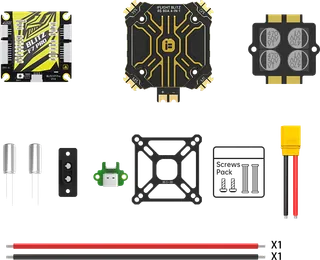
Blitz H7 Pro Combo (E80 ESC) · iFlight
Large 35 x 35 mm H7 stack with a shielded flight controller, microSD blackbox and an 80A ESC for heavy 7 inch and bigger builds. Highest price here.
Suggest a change
Related comparisons
-
 3D-printable long-endurance quadcopters (18650 and 21700)
Printable quadcopter frames that run on single Li-ion cells fly far longer than the same size of drone on a LiPo, but the real decision is size, cell format and how many cells. This grid compares fourteen published designs and builds, from a 3 inch single 18650 to a 4S 21700 4 inch frame, with two non-printed benchmarks (a one-hour ArduPilot quad and a 34-minute single-cell quad), on flight time and how it was measured, weight, cells, print difficulty, GPS and phone-link support, and an estimated box footprint. It is honest about the gaps: almost no design documents a phone link, and most flight times are the designer's own claim.
-
 Beginner FPV drone kits
A ready-to-fly FPV kit puts a drone, goggles and a radio in one box, so a first-time pilot can fly the same day. This grid compares beginner kits from BetaFPV, EMAX, GEPRC, HGLRC and DJI: analog whoops from about $120 to $360, an HDZero digital kit at $525, and three DJI digital combos at $599, $979 and $1,019. The real trade-offs are price against flight time, brushless power against forgiveness, open standards (ExpressLRS, Betaflight, analog goggles) against a polished closed system, and what the box leaves out, such as spare batteries, a charger or radio batteries.
-
 FPV radio transmitters
The transmitter is the one piece of FPV gear you keep through every drone you own. This grid compares the radios hobbyists actually buy, from the cheapest pocket radios to full-size touchscreen radios: link (ExpressLRS, Crossfire, Tracer), firmware (EdgeTX or fixed), size and weight, gimbals, screen, batteries, module bay and simulator support. The real trade-offs are size against comfort, open EdgeTX against simple fixed firmware, and how much range you need.
-
 Digital FPV video systems
Digital FPV replaced the fuzzy analog picture with HD video, but each system is its own ecosystem: goggles and air units from one brand do not work with another's. This grid compares the main systems as a pilot buys them, goggles plus air unit, from the cheap analog baseline up to DJI's flagship, so you can weigh price, latency, picture quality, weight, range and openness before committing.
-
 Grass seed
 comes as single species, regional blends, and seed-plus-fertilizer products, and the right one depends on your climate, how much sun the spot gets, and whether you are starting a new lawn, overseeding, or patching. This grid compares the main national brand lines and farm-direct mixes on grass type, shade and drought tolerance, germination time, seeding rate, price per pound, and whether fertilizer is included.
-
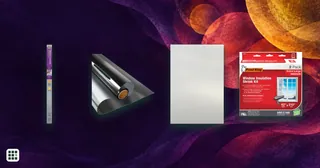 Window film
 is a thin layer you stick to glass to change what the window does: reflect heat, hide the view in, soften light, or insulate against drafts. This grid compares do-it-yourself films for home windows on price, privacy day and night, heat and UV blocked, how they attach, and whether you can take them off and reuse them.